
Automatic Watch: How It Works, Winding and Care
How a self-winding movement turns the motion of your wrist into time, and how to look after one.
Key takeaways
- An automatic watch is a mechanical watch that winds itself through a rotor that spins as you move.
- A fully wound automatic usually runs for about 38 to 72 hours off the wrist before it stops.
- Typical accuracy is around ±5 seconds a day; COSC chronometers must average −4 to +6 seconds a day.
- A watch winder keeps it running between wears, but it is a convenience, not a necessity.
- Plan a full service roughly every 5 to 8 years, and keep it away from strong magnets.
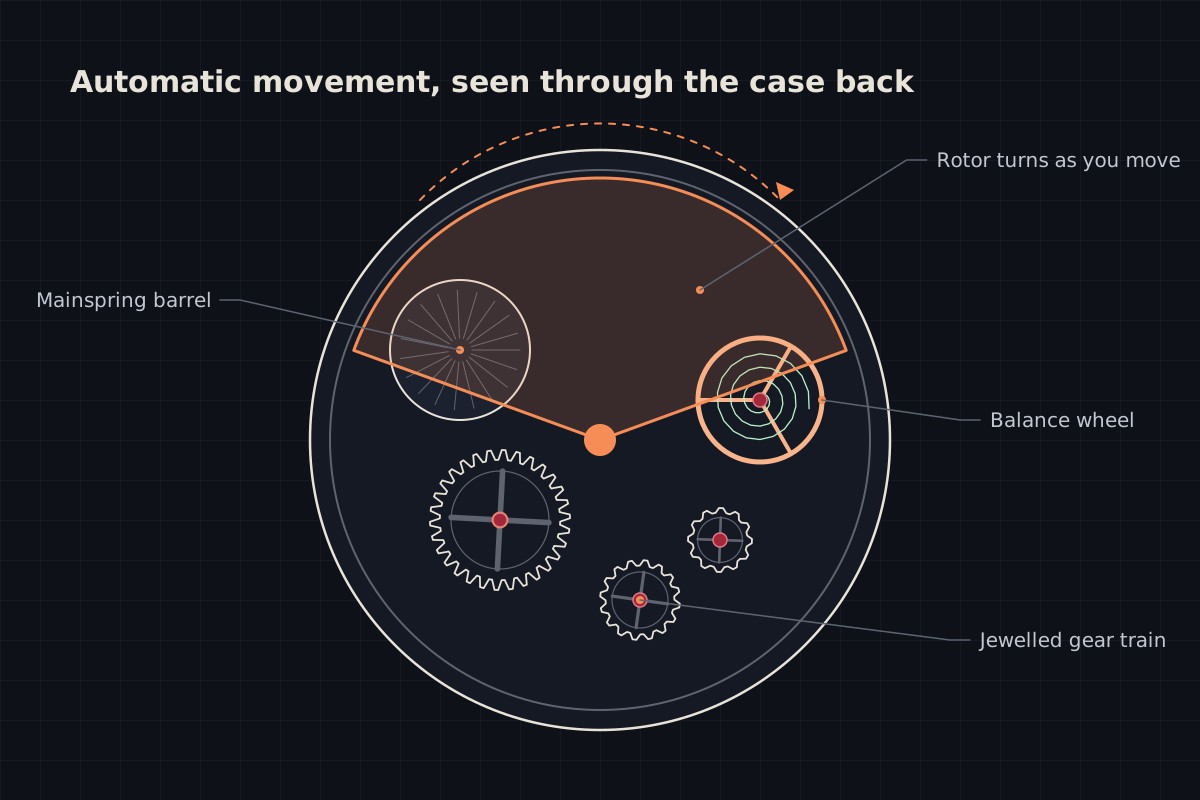
An automatic watch winds itself from the natural motion of your wrist, so it never needs a battery. Inside, a small weight spins as you move and tightens a spring. That spring then drives the hands through a chain of tiny gears. In this guide, you will learn how the movement works, how accurate it is and how to look after it.
What is an automatic watch?
An automatic is a self-winding type of mechanical watch. Like any mechanical piece, it stores energy in a coiled spring and releases it slowly. The difference is how the spring gets wound. Instead of turning the crown every morning, you let a rotor do the work as you go about your day.
The idea is older than the wristwatch. In fact, Swiss watchmaker Abraham-Louis Perrelet built a self-winding pocket watch around 1776 to 1777. Later, John Harwood patented a wristwatch system in 1923, using a weight that swung back and forth. Then Rolex refined the design around 1930 to 1931 with a rotor that turns a full circle, and most modern automatics still follow that layout.
How an automatic watch works
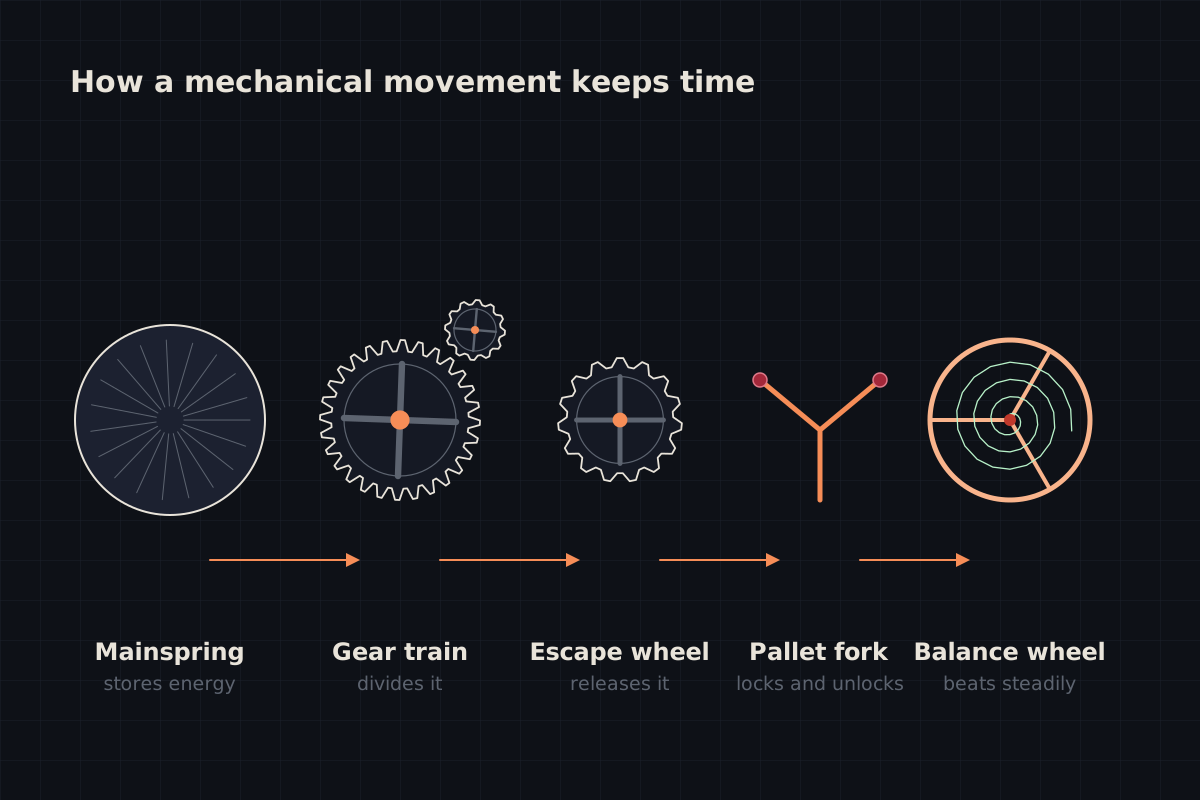
Every automatic has four main stages. First, the rotor collects energy from your movement. Second, the mainspring stores it. Third, the gear train carries it towards the hands. Finally, the escapement and balance wheel release it in small, even steps so the watch keeps steady time.
The rotor
The rotor is a half-moon shaped weight mounted on a central pivot. Because it is heavier on one side, gravity pulls it round whenever you tilt or swing your wrist. Through a set of small reversing wheels, that spinning motion winds the mainspring. Many rotors wind in both directions, while some wind in only one.
The mainspring
The mainspring is a long ribbon of springy metal coiled inside a drum called the barrel. As you wind it, it tightens and stores energy. Then it slowly unwinds, turning the barrel and driving the gears. To protect it, automatics use a slipping clutch. So once the spring is full, any extra winding simply slips instead of adding strain.
The escapement and balance wheel
Without control, the mainspring would unwind in seconds. Instead, the escapement lets the gears move forward one tiny step at a time. Meanwhile, the balance wheel swings back and forth at a steady rate, like a small pendulum. Each swing unlocks the next step. This is also why the seconds hand seems to sweep rather than tick.
Automatic watch power reserve
Power reserve is how long an automatic watch keeps running after you take it off. Most automatics run for around 38 to 72 hours on a full wind. Some modern calibres last much longer, but two to three days is typical. In practice, that means a watch you take off on Friday night may stop by Monday morning.
Some models show the remaining reserve on the dial with a small gauge. That is handy, although not essential. If the watch does stop, you can restart it by hand, which the winding section below explains. Also, note that a watch worn only for an hour may not be fully wound, especially if you sit still at a desk most of the day.
How accurate is an automatic watch?
A typical automatic watch keeps time to within about ±5 seconds a day. That is good for a machine, yet far looser than a quartz watch, which usually drifts only about 15 seconds a month. Position, temperature and how fully the spring is wound all shift the rate. For a full side-by-side view, read our quartz vs automatic watch guide.
COSC chronometer certification
Some automatics carry the word "chronometer" on the dial. This means the Swiss testing body COSC checked the bare movement for 15 days, in five positions and at three temperatures. To pass, it must average between minus 4 and plus 6 seconds a day. According to Wikipedia, only about 5% of Swiss mechanical watches carry this certificate. Rolex submits the largest number each year.
Beyond COSC, some brands set stricter tests of their own. For example, OMEGA's Master Chronometer standard tests the finished watch, including resistance to magnetic fields of 15,000 gauss. Rolex also tests each cased watch in-house to its Superlative Chronometer limit of −2/+2 seconds a day. So the dial wording can tell you a lot about the care behind a movement.
Watch winders for an automatic watch
A watch winder is a small motorised box that gently turns your watch when you are not wearing it. As a result, the rotor keeps spinning and the watch never stops. This is most useful if you own several automatics, or if your watch has a perpetual calendar or moon phase that takes time to reset.
Most winders let you choose the direction and the number of turns per day. Your brand will usually list the right settings for your calibre. That said, a winder is a convenience rather than a necessity. Letting an automatic stop and then winding it again later does it no harm at all.
How to wind and set an automatic watch
If your watch has stopped, a few gentle turns of the crown will bring it back to life. Follow these steps, and always check your manual first, because crown layouts vary between models.
- If the crown screws down, turn it anticlockwise until it pops free.
- With the crown in its first position, turn it gently forwards to wind the mainspring until the seconds hand starts, then add more turns.
- Pull the crown out to the time position, set the hands, then push it back in.
- Set the date in its own crown position, if your watch has one.
- Finally, push the crown in and screw it down firmly, if it is a screw-down type.
Servicing your automatic watch
Like a car engine, an automatic watch needs fresh oil over time. During a full service, a watchmaker takes it apart, cleans each part, replaces worn pieces and oils it again. Then they regulate it and test the seals. Bob's Watches suggests a full service roughly every 5 to 8 years, while Bulova suggests every 3 to 5 years. Therefore, follow your own maker's advice.
Watch for warning signs between services. For instance, a big change in accuracy, a shorter power reserve or a gritty feel when you wind the crown can all point to dried oil or wear. Servicing early is usually cheaper than repairing damage later. You can find authorised centres in our service centre directory.
Magnetism and everyday care
Magnets are a common, hidden problem for any automatic watch. If the thin hairspring inside the balance becomes magnetised, its coils can stick together. As a result, the watch may suddenly run minutes fast each day. Phone cases, tablet covers, speakers and handbag clasps often contain strong magnets. So try not to rest your watch on them.
Fortunately, a watchmaker can usually demagnetise a watch in a few minutes. Beyond magnets, avoid hard knocks, sudden temperature changes and chemicals such as perfume on the strap. Also, check the water rating before you swim, and never use the crown or pushers underwater unless the maker says you can.
Display case-backs
Many automatics have a clear sapphire case back. This lets you see the rotor spin and the balance wheel swing. For many owners, it is a big part of the appeal. It also shows off decoration, such as striped or circular patterns on the bridges, which finer makers apply by hand.
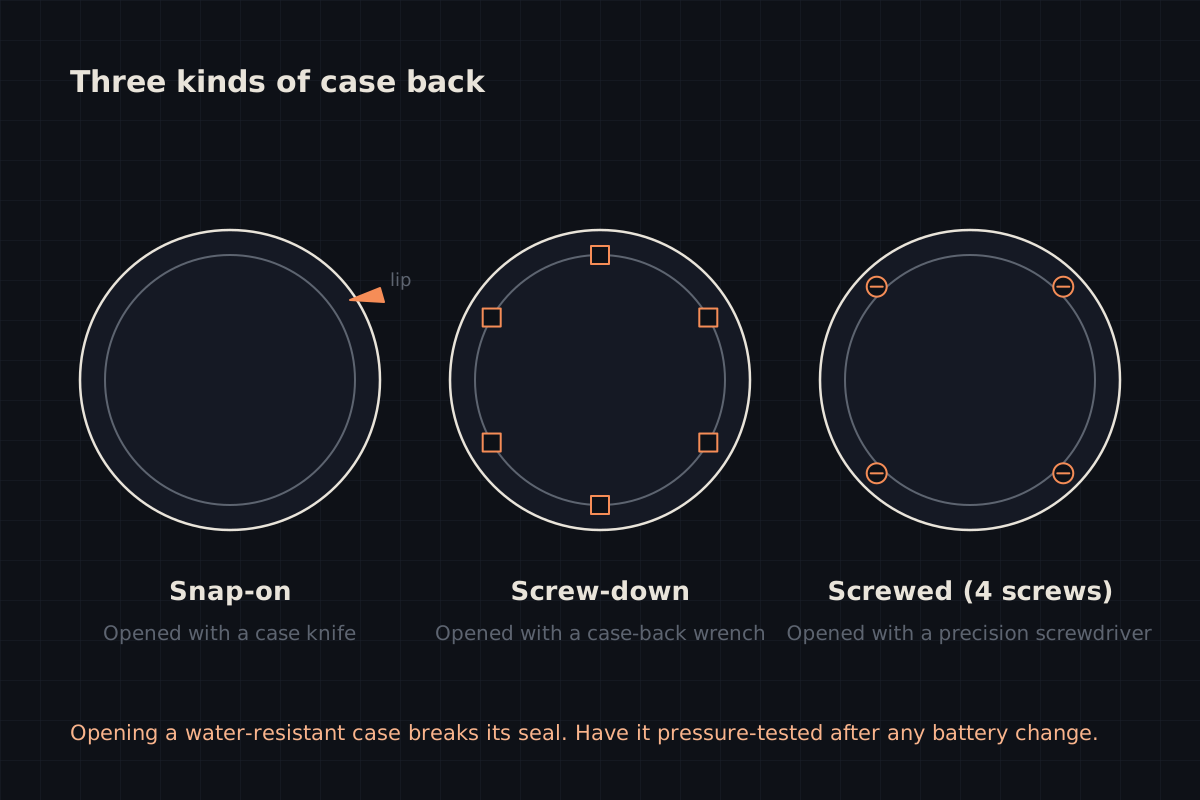
A display back is not always better, however. Solid steel backs are tougher, and they often carry engravings. So pick the style you prefer. If you want to explore makers known for fine finishing, our guide to luxury watch brands is a good next step.
Is an automatic watch right for you?
An automatic suits you if you enjoy craft, history and a movement that can last for generations. It also suits daily wearers, because regular use keeps it wound. On the other hand, if you want perfect time with no effort, quartz may be the better fit. Either way, you now know what makes a self-winding movement tick. For deeper reading, the history of self-winding watches is a good place to start.
Frequently asked questions
What is an automatic watch?
It is a mechanical watch that winds itself. A weighted rotor inside the case spins as you move your wrist, and that motion winds the mainspring. The spring then slowly releases energy through gears and an escapement to move the hands. It needs no battery, but it stops if you leave it unworn too long.
How long does an automatic watch run without wearing?
Most automatics run for about 38 to 72 hours once fully wound, though some modern calibres reach several days. The exact figure is the power reserve, which your manual or the brand's website will list. If the watch stops, wind it by hand through the crown or simply wear it again.
Do I need a watch winder?
No. A watch winder is a convenience that keeps your automatic running between wears, so you do not have to reset the time and date. It is useful if you own several watches or have complicated calendars. Otherwise, letting the watch stop and winding it again later does no harm.
How often should an automatic watch be serviced?
Many watchmakers suggest a full service roughly every 5 to 8 years, while some brands recommend every 3 to 5 years. Always follow your maker's manual. Signs it needs attention sooner include large changes in accuracy, a shorter power reserve, or a rough feel when you wind the crown.
Can you overwind an automatic watch?
No. Automatic movements use a slipping clutch on the mainspring, so once the spring is fully wound, extra winding simply slips without adding tension. You can wind it by hand or wear it all day without risk. Hand-wound watches are different, so stop turning when you feel resistance.
Sources
- Wikipedia: Automatic watch
- Wikipedia: COSC (Contrôle officiel suisse des chronomètres)
- Wikipedia: Mechanical watch
- Bob's Watches: Quartz vs automatic movement
- Bulova: Watch movement types explained
- OMEGA: Master Chronometer certification
- Rolex: Precision and the Superlative Chronometer
Prices, specifications and availability change. Check the brand's official Malaysian site or an authorised retailer before you buy.