
Watch Glossary: Watch Terms Explained in Plain English
Sixty common watch terms, from bezel and crown to tourbillon and ISO 6425, grouped by theme so you can find each one fast.
Key takeaways
- Terms are grouped into case and dial, movement, complications, straps and fit, and water resistance.
- Sapphire watch glass resists scratches best; mineral glass is cheaper; acrylic scratches easily but can be polished.
- A COSC chronometer has passed 15 days of tests within −4/+6 seconds a day.
- Water resistance in metres is a lab pressure rating, not a safe diving depth.
- ISO 6425 is the standard for divers' watches, which must be rated to at least 100 m.
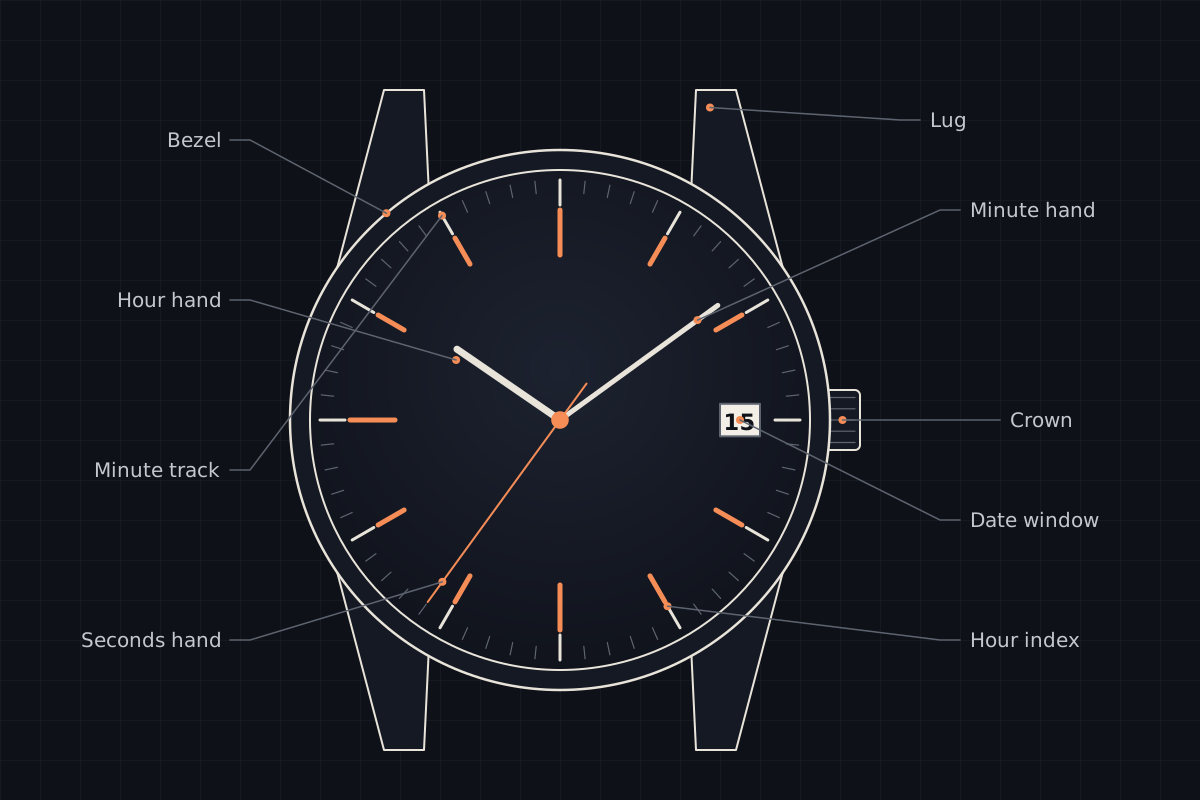
This watch glossary explains the words you meet when you read a spec sheet, browse a shop or talk to a watchmaker. Watch language can feel like a code, because many terms come from French, Swiss or naval tradition. So we have grouped the terms by theme, defined each one in plain English and linked to deeper guides where they help. You can read the watch glossary from top to bottom or jump straight to the section you need.
How to use this watch glossary
The terms below fall into five groups: case and dial, movement, complications, straps and fit, and water resistance. Within each group, related terms sit together, for example sapphire next to mineral glass. In addition, the figures quoted here, such as COSC limits and ISO test pressures, come from the official standards or the brands themselves. If a word you need is missing from this watch glossary, the closest guide linked in that section will usually cover it.
Watch glossary: case and dial
In this watch glossary, these are the parts you can see and touch. Above all, they decide how a watch looks and how it sits on your wrist.
Bezel and crown: watch glossary basics
Bezel: The ring around the crystal that holds it in place. It can be fixed and decorative, or it can rotate and carry a scale, such as a dive timer or a 24-hour scale.
Crown: The small knob on the side of the case, usually at three o'clock. You use it to set the time and date and, on mechanical watches, to wind the mainspring.
Screw-down crown: A crown that screws onto a threaded tube so it seals tightly. Because it locks, it improves water resistance, so you must unscrew it before setting the time.
Crown guards: Raised shoulders on the case beside the crown. They protect it from knocks, which is why they are common on sports and dive watches.
Crystal types
Crystal (watch glass): The clear cover over the dial. It comes in three main types, and each trades scratch resistance against toughness.
Sapphire crystal: Synthetic sapphire, very hard and highly scratch-resistant, so it stays clear for years. However, it can crack under a sharp impact, and it costs more than other glass.
Mineral glass: Hardened glass used on many affordable watches. It resists knocks well but scratches more easily than sapphire.
Acrylic (Hesalite or plexiglass): A plastic crystal common on vintage watches. It scratches easily, yet light marks polish out, and it rarely shatters.
Anti-reflective (AR) coating: A thin layer on the crystal that cuts glare, so you can read the dial in bright light.
Dial details
Dial: The face of the watch under the crystal. It carries the hour markers, the logo and any sub-dials.
Indices (hour markers): The marks that show each hour. They can be printed, or applied as separate polished pieces for extra depth.
Sub-dial: A small dial within the main dial. It usually shows running seconds or a chronograph count.
Date window: An opening in the dial that shows the date. Some watches add a magnifier, often called a cyclops lens, on the crystal above it.
Lume: Luminous material on hands and markers that glows in the dark. Modern watches use non-radioactive pigments, while older ones used radium or tritium.
Case and measurements
Case: The metal housing that protects the movement. Common materials include stainless steel, titanium, gold, ceramic and resin.
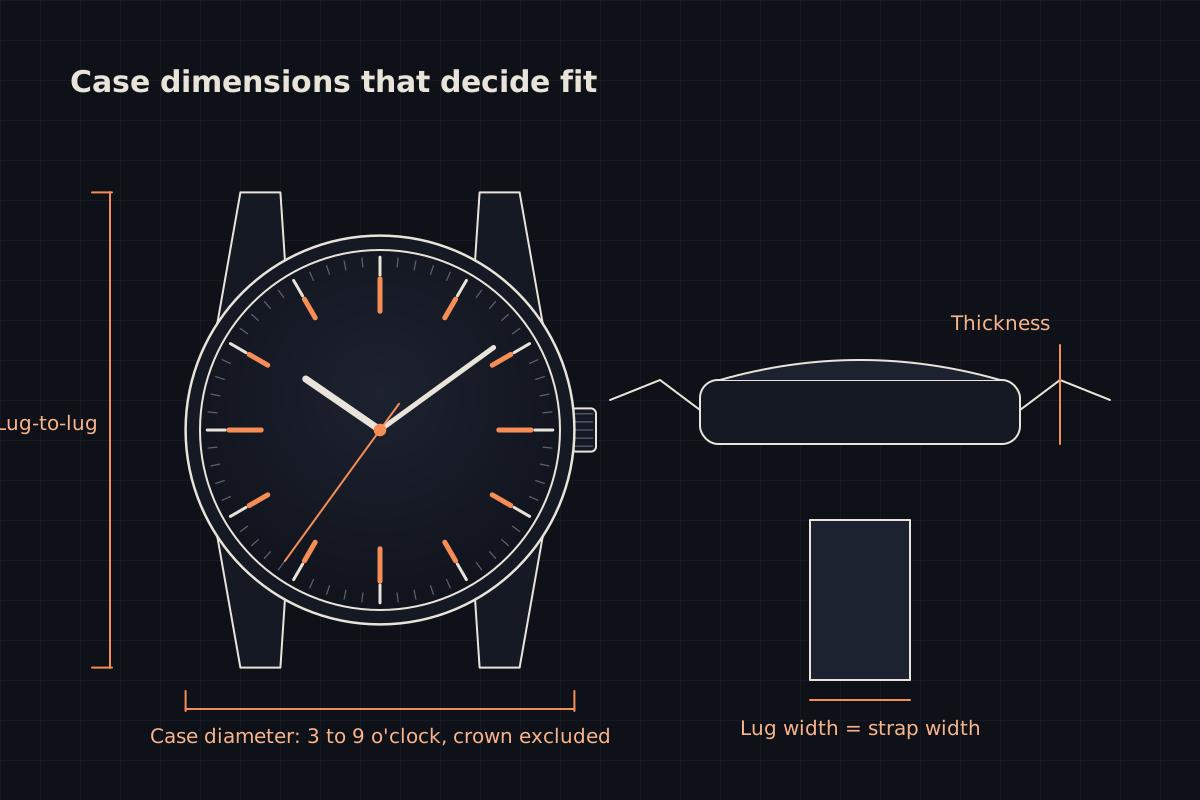
Case diameter: The width of the case, measured from three to nine o'clock, not counting the crown. Our watch size guide shows how to match it to your wrist.
Lugs: The horns at the top and bottom of the case that hold the strap or bracelet.
Lug-to-lug: The distance from the tip of the top lugs to the tip of the bottom lugs. In fact, it often matters more for fit than diameter, so check the lug-to-lug measurement before you buy.
Lug width: The gap between the lugs, in millimetres. It tells you which strap width will fit, for example 20 mm.
Caseback: The back cover of the case. It may snap on, screw down or be held by small screws.
Display caseback (exhibition caseback): A caseback with a sapphire window, so you can see the movement inside.
Watch glossary: movement
The movement is the engine of the watch, and it has the most jargon in any watch glossary. These terms describe how it is powered and how well it keeps time.
Movement types
Movement (calibre): The mechanism inside the case that drives the hands. Brands often give each movement a calibre number.
Quartz movement: A battery-powered movement regulated by a vibrating quartz crystal. As a result, it is cheap, accurate and low-maintenance.
Mechanical movement: A movement powered by a wound spring rather than a battery. It needs no battery, but it needs regular servicing.
Hand-wound (manual): A mechanical watch that you wind by turning the crown, usually once a day.
Automatic (self-winding): A mechanical watch that winds itself as you move your wrist. Our guide to the automatic watch explains how it works.
Inside a mechanical movement
Rotor: The weighted half-disc inside an automatic watch. It spins as you move, and so it winds the mainspring.
Mainspring: The coiled spring that stores energy in a mechanical watch. It sits in a drum called the barrel.
Balance wheel: The wheel that swings back and forth at a steady rate. Together with its hairspring, it acts as the watch's regulator.
Escapement: The part that releases the mainspring's energy in small, even steps. That is why a mechanical watch ticks.
Jewels: Tiny synthetic rubies used as bearings at points of friction. More jewels do not always mean a better watch, although most mechanical movements have around 17 or more.
Beat rate (frequency): How many times the balance swings per hour, for instance 28,800 vibrations per hour (4 Hz). A higher rate gives a smoother seconds hand.
Running time, accuracy and certification
Power reserve: How long a fully wound mechanical watch runs before it stops. For example, Rolex lists about 70 hours for the calibre 3230.
Hacking: A feature that stops the seconds hand when you pull out the crown. Thus you can set the time to the exact second.
Chronometer: A watch whose movement has passed an official accuracy test. In Switzerland, that test comes from COSC.
COSC: The Contrôle Officiel Suisse des Chronomètres, the Swiss testing body. According to COSC, it tests movements for 15 days, and a certified watch must stay within −4 to +6 seconds a day on average.
Spring Drive: A Seiko and Grand Seiko movement that uses a mainspring for power but regulates speed with a quartz-controlled system. Its seconds hand therefore glides rather than ticks.
In-house (manufacture): A movement designed and made by the watch brand itself, rather than bought from a specialist supplier.
Watch glossary: complications
Anything beyond hours, minutes and seconds is a complication, and this part of the watch glossary covers the main ones. These are the ones you are most likely to see.
Timing functions
Complication: Any extra function, such as a date, a stopwatch or a moon display. The more complications, the more complex the movement.
Chronograph: A watch with a built-in stopwatch, usually run by two pushers beside the crown. Read more in our chronograph watch guide.
Flyback: A chronograph that you can reset and restart with one press, instead of stop, reset and start.
Tachymeter: A scale on the bezel or dial that, together with the chronograph, measures speed over a known distance, for example one kilometre.
Time zones and calendars
GMT: A watch that shows a second time zone, usually with an extra 24-hour hand and a 24-hour bezel. Our guide to the gmt watch explains how to set one.
World time: A watch that shows the time in all 24 main time zones at once, using a ring of city names.
Moonphase: A small window that shows the phase of the moon as it waxes and wanes.
Annual calendar: A date display that knows 30- and 31-day months, so you only correct it once a year, at the end of February.
Perpetual calendar: A calendar that also accounts for February and leap years. In theory, it needs no correction until 2100, when the leap-year rule changes.
Quickset date: A crown position that changes the date directly, so you do not have to spin the hands through 24 hours.
High complications
Tourbillon: A rotating cage that holds the balance and escapement, designed to average out errors caused by gravity. According to Breguet, Abraham-Louis Breguet patented it in 1801. Our guide to the tourbillon watch and other mechanical types goes further.
Skeleton: A watch with parts of the dial and movement cut away, so you can see the mechanism working.
Minute repeater: A complication that chimes the hours, quarters and minutes on demand, using tiny hammers and gongs.
Straps and fit
In this part of the watch glossary, the focus is fit. How a watch attaches to your wrist affects comfort as much as size does. Also, the right strap can change the whole look of a watch.
Bracelet: A metal band made of linked pieces. Steel bracelets are the most common, while titanium ones are lighter.
End link: The piece that joins a bracelet to the case between the lugs. A solid end link feels sturdier than a folded one.
Spring bar: The small spring-loaded pin that holds a strap or bracelet between the lugs. Quick-release spring bars have a lever, so you can swap straps without tools.
Deployant clasp: A folding clasp that opens and closes on hinged blades. Unlike a pin buckle, it keeps the strap from bending in the same place every day.
Micro-adjustment: A small extension in a bracelet clasp that lets you fine-tune the fit. Rolex's Glidelock, for example, adjusts without tools.
NATO strap: A single-piece nylon strap that threads under the spring bars. It is cheap, tough and quick to change. For more options, see our watch strap guide.
Watch glossary: water resistance and standards
Water resistance terms cause more confusion than any other part of this watch glossary. So read these carefully before you swim.
Water resistance: A rating, in metres, bar or ATM, that shows the pressure a case passed in a lab test. However, it is not a safe diving depth. As a rough guide, 30 m suits rain and splashes, while 100 m suits swimming.
ATM (atmosphere): A unit of pressure. One ATM is roughly one bar, or about 10 metres of static water pressure.
ISO 22810: The international standard for general water-resistant watches.
ISO 6425: The international standard for divers' watches. Under it, a watch must be rated to at least 100 m and be tested to 125% of its rated pressure, among many other checks. A true dive watch often meets this standard.
Unidirectional bezel: A dive bezel that turns only anticlockwise. That way, an accidental knock can only shorten the timed dive, never lengthen it.
Helium escape valve: A small valve that releases helium gas from the case during decompression. It matters for saturation divers rather than most swimmers.
Gasket: A rubber seal at the crown, caseback and crystal. Because gaskets age and harden, a watchmaker should test water resistance regularly.
Getting more from this watch glossary
Once these words feel familiar, spec sheets become much easier to compare. For instance, you can now see why a watch with sapphire glass, a screw-down crown and 200 m water resistance suits daily wear better than one with acrylic and 30 m. Similarly, a COSC certificate or a long power reserve tells you something concrete about a movement. Overall, a watch glossary works best as a quick reference. Keep this watch glossary handy when you shop, and use it alongside our deeper guides to check any term you are unsure of.
Frequently asked questions
What is the bezel on a watch?
The bezel is the ring around the watch glass that holds the crystal in place. On many watches it is purely decorative. On dive, GMT and chronograph watches, it often rotates or carries a scale, such as a 60-minute dive timer, a 24-hour scale for a second time zone or a tachymeter for measuring speed.
What is the crown on a watch?
The crown is the small knob on the side of the case, usually at three o'clock. You turn it to set the time and date and, on hand-wound or automatic watches, to wind the mainspring. A screw-down crown locks against the case to improve water resistance, so you unscrew it before use.
What is the best watch glass?
Sapphire crystal is usually the best choice for daily wear because it is very hard and resists scratches. However, it can shatter under a sharp knock. Mineral glass is cheaper and tougher against impact but scratches more easily. Acrylic is light and shatter-resistant, and small scratches can be polished out at home.
What is a watch dial?
The dial is the face of the watch, the plate under the crystal that carries the hour markers, logo and any sub-dials. Dials come in many finishes, such as sunburst, lacquer, enamel or textured patterns. Hour markers can be printed or applied as separate metal pieces, often with lume for reading in the dark.
What does ATM mean on a watch?
ATM stands for atmospheres, a unit of pressure. One ATM is roughly one bar or about 10 metres of static water pressure in a lab test. So 5 ATM means the case passed a test equal to about 50 metres. It does not mean you can dive to that depth safely.
Sources
- COSC: Chronometer certified
- ISO: ISO 6425:2018 Horology, divers' watches
- Breguet: 1801, patent for the tourbillon regulator
- Rolex Malaysia: Submariner technical details (Glidelock, Triplock, power reserve)
- Grand Seiko: Spring Drive
- Timex: Water resistant vs waterproof watches
- Bulova: Watch movement types explained
- Time+Tide: Vintage watch terms glossary
Prices, specifications and availability change. Check the brand's official Malaysian site or an authorised retailer before you buy.