
Quartz vs Automatic Watch: Accuracy, Cost and Care Compared
A plain-English guide to the two watch movement types most buyers choose between, and how to decide which one fits your life.
Key takeaways
- Quartz runs on a battery and a crystal vibrating at 32,768 Hz, so it typically drifts only about 15 seconds a month.
- An automatic winds itself from your wrist movement and usually keeps time to within a few seconds a day.
- Quartz needs a battery every few years; an automatic needs a full service roughly every 5 to 8 years.
- Quartz seconds hands tick once a second, while automatic seconds hands sweep in small steps.
- Choose quartz for grab-and-go accuracy and low cost; choose automatic for craft, longevity and the joy of a machine.
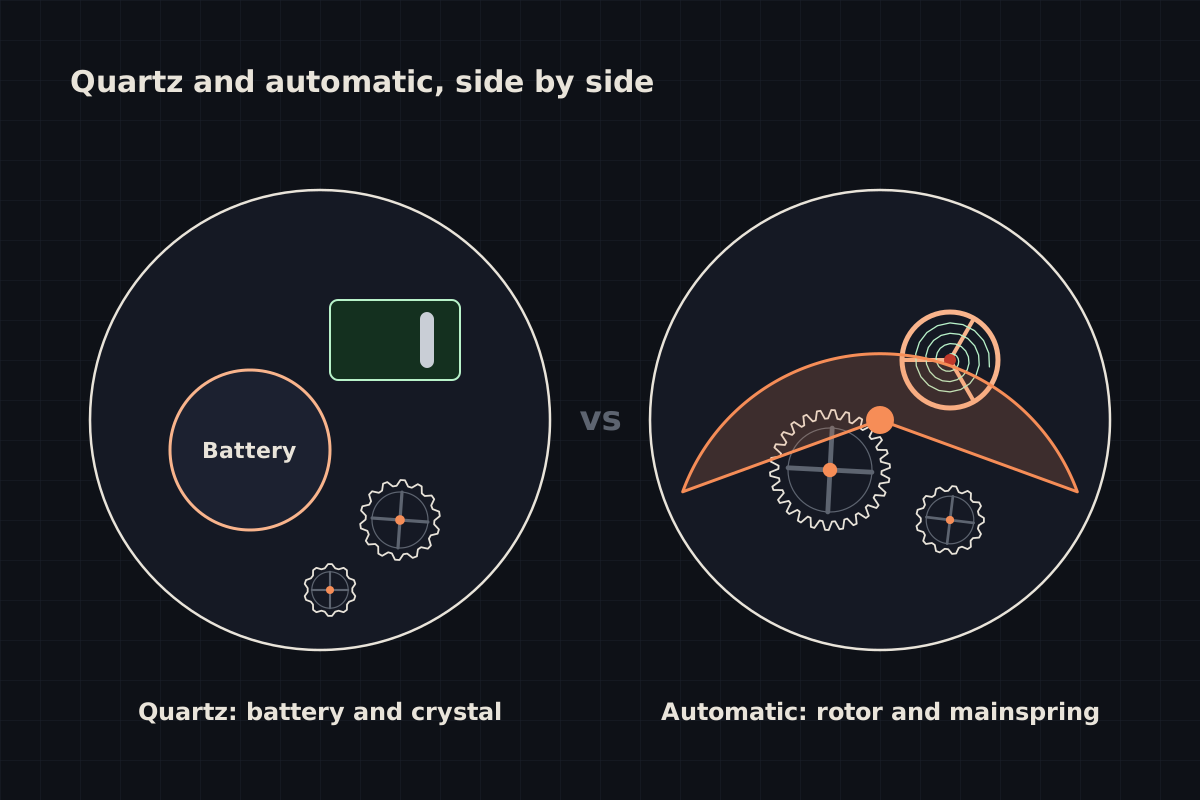
The quartz vs automatic watch debate is the first big choice most buyers face. In short, it is a choice between battery-powered precision and a tiny machine that runs on your own movement. Both kinds tell good time, yet they feel very different to own. This guide compares accuracy, servicing, cost and lifespan, so you can match the movement to the way you live.
Quartz vs automatic watch: the short answer
A quartz watch uses a battery to make a tiny crystal vibrate at a fixed speed. A circuit counts those vibrations and moves the hands. As a result, it keeps very accurate time and asks almost nothing of you. An automatic watch, by contrast, has no battery at all. Instead, a swinging weight winds a spring as you move, and that spring drives a set of gears.
So the quartz vs automatic watch choice is really about priorities. If you want the right time with zero effort, quartz is hard to beat. On the other hand, if you enjoy craft, history and a living mechanism on your wrist, an automatic offers something a battery cannot. Neither is better in every way. That said, each one suits a different kind of owner, and the sections below show you which one you are.
How a quartz movement works
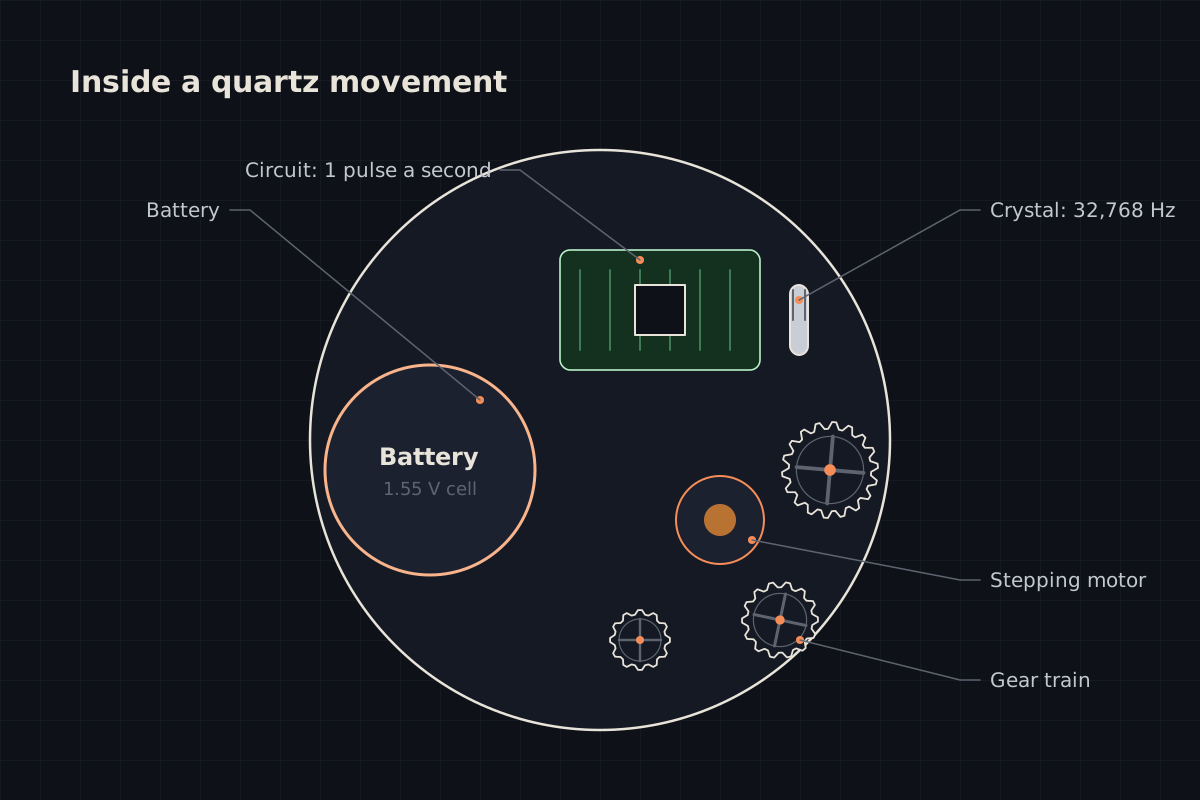
Inside every quartz movement sits a small piece of quartz cut into the shape of a tuning fork. Quartz has a useful property: when you pass a current through it, it bends, and it vibrates at a very steady rate. In watches, the crystal vibrates 32,768 times per second. That number is two to the power of 15, so a simple circuit can halve it 15 times to get exactly one pulse per second.
Each pulse then reaches a tiny stepping motor. The motor turns a short gear train, which moves the hands forward. Because the crystal is so steady, a standard movement typically drifts only about 15 seconds a month. Also, there are very few moving parts, so there is little to wear out. The main job for you is a watch battery replacement every two to five years, depending on the model.
How an automatic movement works
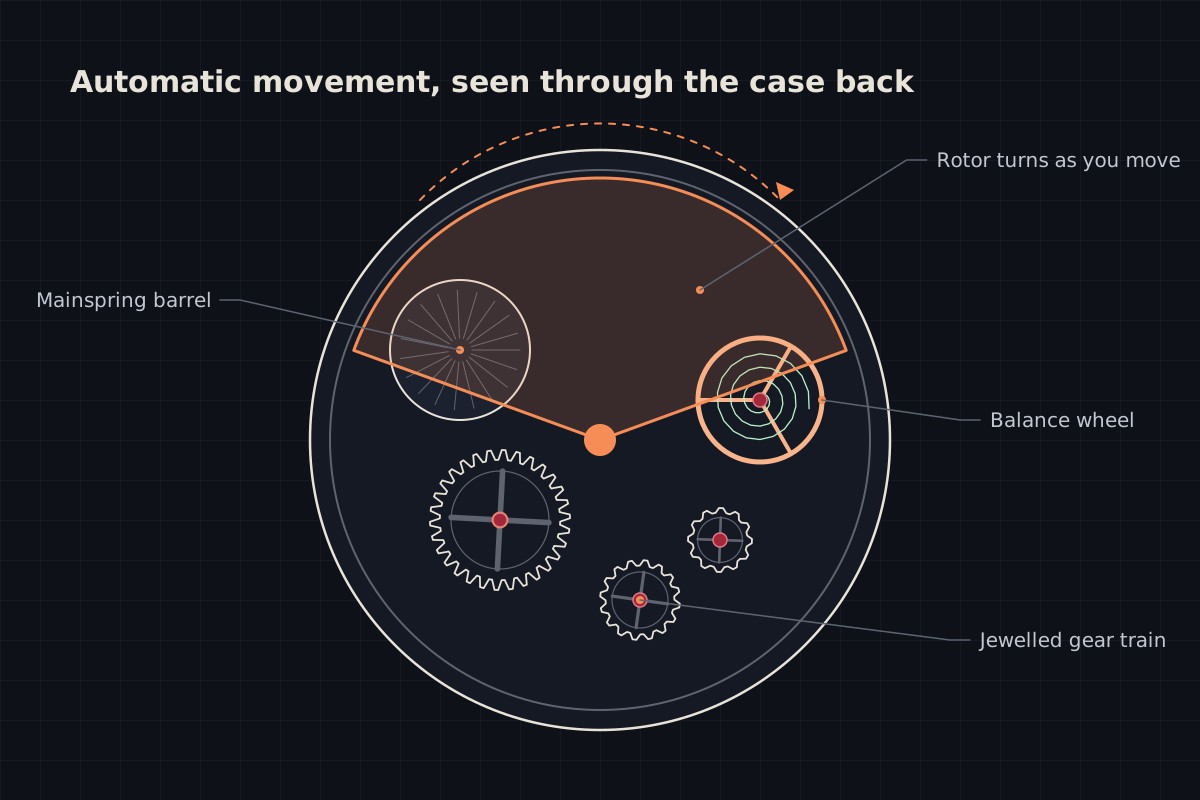
An automatic is a self-winding type of mechanical watch. Its power comes from a coiled ribbon of steel called the mainspring. As the spring slowly unwinds, it turns a chain of gears. Then a part called the escapement releases that energy in small, even steps, while a balance wheel swings back and forth like a tiny pendulum. Each swing lets the gears move forward by a fixed amount.
The clever part is the rotor. This is a half-moon weight that spins on a pivot whenever your wrist moves. As it turns, it winds the mainspring for you. In fact, Rolex refined the full-turn rotor design around 1930 to 1931, and most automatics still follow that idea. Once fully wound, many automatics run for around 38 to 72 hours off the wrist before they stop.
Quartz vs automatic watch comparison table
If you only read one part of this guide, make it this table. It sets the quartz vs automatic watch differences side by side on the points that matter most to owners. However, remember that the figures are typical ranges. Your own watch may do better or worse, so always check the manual from your brand.
| Feature | Quartz | Automatic |
|---|---|---|
| Accuracy | About ±15 seconds a month | Roughly ±5 seconds a day (chronometer: −4/+6 s/day) |
| Power source | Battery, or a light or motion charged cell | Mainspring wound by a rotor and your wrist |
| Maintenance | Little beyond fresh batteries and seal checks | Regular wear or a winder, plus periodic servicing |
| Servicing interval | Battery every 2 to 5 years | Full service about every 5 to 8 years |
| Price | Low entry price; cheap to run | Higher to buy and to service |
| Seconds-hand motion | Ticks once per second | Smooth sweep in many small steps |
| Lifespan | Decades, though old circuits can be scarce | Generations, if serviced and repaired |
Accuracy in a quartz vs automatic watch
On pure timekeeping, the quartz vs automatic watch contest is one-sided. A standard quartz watch gains or loses about 15 seconds in a month. By comparison, a decent automatic often drifts around 5 seconds in a single day. Over a month, that can add up to more than two minutes. In other words, a cheap quartz will usually beat a costly automatic on precision.
What COSC certification means
Some automatics carry the word "chronometer" on the dial. This means the Swiss testing body COSC checked the movement for 15 days, in five positions and at three temperatures. To pass, it must average between minus 4 and plus 6 seconds a day. That is excellent for a mechanical movement. Even so, it is still looser than an ordinary quartz, which shows how wide the accuracy gap really is.
What affects automatic accuracy
Mechanical timekeeping changes with conditions. For example, the position you leave the watch in overnight, the temperature and how fully the spring is wound can all shift the rate. Magnets also matter, because a magnetised hairspring can make a watch run very fast. Phone cases, laptop speakers and handbag clasps often hide strong magnets, so keep your automatic away from them when you can.
Servicing a quartz vs automatic watch
Running costs are where the quartz vs automatic watch gap feels most real. A quartz piece mostly needs a new battery every few years. Bob's Watches puts a typical replacement at around US$10 to US$20 in the United States. While the case is open, a good technician should also check the gaskets, since worn seals let in moisture. That matters in a humid climate like Malaysia.
An automatic, meanwhile, needs a full service. The watchmaker strips the movement, cleans every part, replaces worn pieces, oils it and regulates it. Bob's Watches suggests this every 5 to 8 years, at around US$200 to US$800 or more. Some brands recommend shorter gaps, and Bulova suggests every 3 to 5 years. Therefore, always follow your own maker's advice rather than a general rule.
The seconds hand on a quartz vs automatic watch
The quickest way to tell the two apart is to watch the seconds hand. On most quartz models, it jumps forward once every second, because the motor receives one pulse per second. On an automatic, the hand moves in many tiny steps each second. As a result, it seems to glide smoothly around the dial.
The smoothness depends on the beat rate. A common modern automatic beats 28,800 times per hour, which means eight small steps every second. Older or simpler calibres may beat 21,600 times per hour, so the sweep looks slightly choppier. For many owners, that flowing motion is the moment an automatic starts to feel alive.
Lifespan, value and feel
An automatic can last for generations. Because every part is mechanical, a skilled watchmaker can clean, repair or even remake components. That is why decades-old automatics still tick away today. Quartz movements also last for many years. However, if an old circuit fails and the maker no longer stocks it, the fix may be a whole new movement.
Value follows the same logic in the quartz vs automatic watch debate. Collectors tend to prize mechanical craft, so most luxury watch brands build their range around automatics. Still, there are respected exceptions, and some high-end quartz pieces have loyal fans. Finally, there is feel. An automatic is usually a little heavier and thicker, and many people enjoy seeing the rotor spin through a glass case back.
Hybrids between quartz and automatic watches
Not every watch sits neatly on one side. Several makers have blended the two ideas, which blurs the quartz vs automatic watch line. For example, Citizen's Eco-Drive is a quartz watch charged by light. Its solar cell sits under the dial and feeds a rechargeable cell, so you rarely, if ever, need a battery change. Citizen says many models run for more than six months on a full charge.
Seiko took another route. In 1988, it launched the AGS, later renamed Kinetic. This quartz watch has a rotor, much like an automatic, but the rotor spins a tiny generator. That generator then charges a cell that powers the quartz circuit. In short, you get quartz accuracy with automatic-style winding.
Which should you choose?
There is no single right answer to the quartz vs automatic watch question. Instead, think about how you will actually wear the watch. The scenarios below cover the most common buyers. Find the one closest to you, then read the guide for that movement type before you shop.
Your first quartz or automatic watch
If this is your first proper watch and your budget is tight, quartz is the safe start. It is cheap to buy, cheap to run and always on time. Then again, if you already know you love the idea of a mechanism, an entry-level automatic from a brand like Seiko or Tissot gives you a real movement without a huge outlay. Either way, you will learn quickly what you value.
A watch for daily office wear
If you wear the same watch every working day, the quartz vs automatic watch choice matters less, because both types work well. An automatic stays wound because you move all day, so it rarely stops. Meanwhile, a quartz needs nothing at all. In a hot, humid city, sealed quartz cases with good gaskets also cope well with sweat and sudden rain. Pick based on style and budget rather than reliability.
A watch you wear only sometimes
If you own several watches and rotate them, the quartz vs automatic watch balance tips towards quartz. You can leave it in a drawer for weeks, then pick it up and it still shows the right time. An automatic, by comparison, will stop after a couple of days and need setting again. A watch winder solves this, but it adds cost and another gadget in your home.
A collector's piece or heirloom
If you want something to keep for decades, or to hand on to your children, choose an automatic. Its parts can be serviced and remade almost forever. It also tends to hold value better, especially from respected makers. Above all, an automatic carries a story and a craft that many owners find hard to give up once they have tried it.
Sport, travel and tough use
For hard knocks, quartz has an advantage because it has fewer delicate moving parts. A tough quartz diver or a solar model is ideal for hiking, boating or rough travel. That said, many automatic tool watches handle sport well too. If you like the idea of a modern, connected option instead, a smart watch may suit training better than either.
Final verdict on quartz vs automatic watches
Quartz vs automatic watches is not a contest with a clear winner. Quartz gives you precision, low cost and almost no fuss. An automatic gives you craft, character and a movement that can outlive you. If you are still unsure, try both on in a shop and watch the seconds hand. Most people feel the answer within a minute, and that feeling is usually right.
Want to go deeper? The quartz movement became widespread after Seiko's 1969 Astron, a turning point you can read about in our history of watches. For technical background, the COSC chronometer standard and Grand Seiko's Spring Drive page are both worth a look. You can also read Citizen's own Eco-Drive explainer.
Frequently asked questions
Is a quartz or automatic watch more accurate?
Quartz is far more accurate. A standard quartz movement typically drifts about 15 seconds a month, while a good automatic may gain or lose around 5 seconds a day. Even a certified chronometer is allowed minus 4 to plus 6 seconds a day, so quartz wins on precision every time.
Which lasts longer, quartz or automatic?
With regular servicing, an automatic can run for generations, because a watchmaker can clean, repair or remake its parts. Quartz movements also last for decades, but old circuits can become hard to source. Many cheap quartz movements are simply swapped out rather than repaired when they eventually fail.
Do automatic watches need batteries?
No. An automatic watch stores energy in a coiled mainspring, which a rotor winds as you move your wrist. If you take it off for longer than its power reserve, often around 38 to 72 hours, it stops. You then wind it by hand or wear it again to restart it.
Why are automatic watches more expensive than quartz?
An automatic movement has many small parts that need precise machining, finishing and hand assembly. A quartz movement relies on mass-produced electronics and far fewer moving parts. You are paying for craft, labour and long-term repairability rather than better timekeeping, which is why a cheap quartz can still beat a costly automatic on accuracy.
Is a quartz watch less valuable than an automatic?
Not always. Collectors generally value mechanical craft more, so most automatics hold value better. However, some quartz watches are highly prized, such as Grand Seiko 9F models and historic pieces from the quartz era. Value depends on the brand, condition and rarity as much as the movement inside.
Sources
- Bob's Watches: Quartz vs automatic movement
- Bulova: Watch movement types explained
- Grand Seiko: Spring Drive
- Citizen: Eco-Drive technology
- Wikipedia: Quartz clock
- Wikipedia: Automatic watch
- Wikipedia: COSC (Contrôle officiel suisse des chronomètres)
- Wikipedia: Spring Drive
- Wikipedia: Quartz crisis
- Epson: Seiko AGS, the first automatic generating quartz watch (1988)
Prices, specifications and availability change. Check the brand's official Malaysian site or an authorised retailer before you buy.