
How to Measure Wrist Size for Watch Buying: The Full Size Guide
A tape, ten seconds and three case numbers are all you need to find a watch that fits your wrist properly.
Key takeaways
- Measure your wrist with a soft tape (or string and a ruler) just above the wrist bone, snug but not tight.
- Case diameter runs from 3 to 9 o'clock and leaves out the crown.
- Lug-to-lug often matters more than diameter: if the lugs pass the edges of your wrist, the watch is too big.
- Quick rule: wrist circumference in cm × 2.3 gives a starting case diameter in mm.
- Unsure? A 38–42 mm case suits an average 7–7.5 inch wrist.
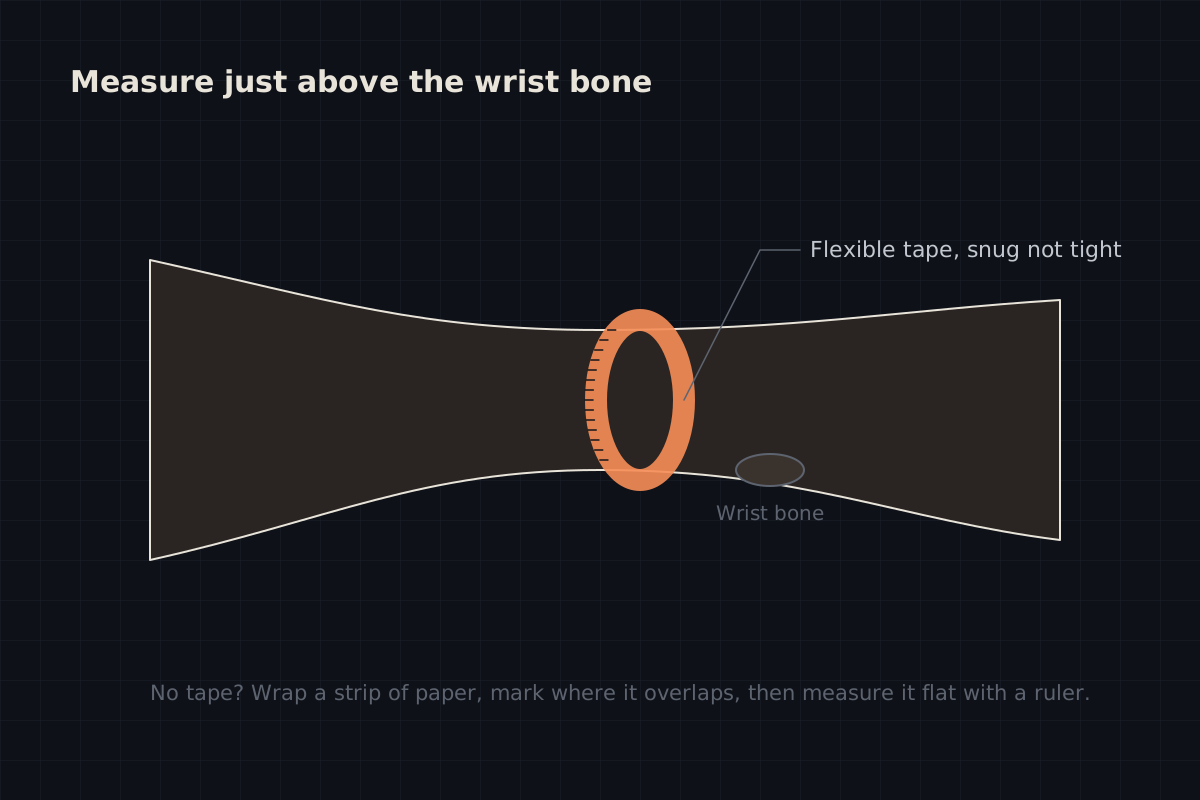
If you want to know how to measure wrist size for watch shopping, all you need is a soft tape and about ten seconds. That one number, together with three case measurements, tells you far more than any product photo. In this guide you will find the steps, the numbers that matter and a chart you can print. As a result, you can shortlist watches online with confidence and then confirm the fit in person.
Why you should measure wrist size before buying a watch
A watch can look perfect in a photo and still feel wrong on your arm. That is because photos hide scale. A 40 mm case may sit neatly on one wrist, yet hang over the edges of another. So knowing your own number first saves time, money and awkward returns. It also helps you read specification sheets, since brands list case sizes in millimetres. In short, once you know how to measure wrist size for watches, every spec sheet starts to make sense.
Of course, size is also a matter of taste. Some people like a small, classic look, while others prefer a bold sports piece. Still, the numbers give you a sensible starting range. For instance, Wristler suggests different ranges for understated, balanced and bold styles at the same wrist size. Our guides to watches for men and watches for women apply the same thinking to specific styles.
How to measure wrist size for a watch, step by step
Here is how to measure wrist size for watch buying at home. Use the wrist you plan to wear the watch on, which is usually your non-dominant hand. Also, measure when your arm is relaxed, not straight after a workout. That way, a snug metal bracelet will still feel comfortable on a hot afternoon.
Using a flexible tape measure
A soft tailor's tape is the easiest tool if you are learning how to measure wrist size for watches. It bends around the wrist, so it gives a true circumference rather than a flat width. Follow these five steps.
- First, find the small bony bump on the outer side of your wrist.
- Next, wrap the tape around your wrist just above that bone, on the arm side.
- Keep the tape flat and snug, but do not let it press into the skin.
- Then read the number where the tape overlaps its zero end.
- Finally, write it down in both centimetres and millimetres, for example 17 cm or 170 mm.
Using string or a paper strip and a ruler
No tape at home? Instead, wrap a piece of string or a thin strip of paper around the same spot. Mark the point where it overlaps with a pen. After that, lay it flat against a ruler and read the length. Watch.co.uk describes the same paper-strip method. This backup way of how to measure wrist size for watches works well, although string can stretch a little, so repeat it twice and take the average.
Watch size calculator
Enter your wrist measurement to get a starting case diameter and a lug-to-lug range.
Starting diameter = wrist (cm) × 2.3 (Wristler). Ranges follow Wristcheck's size bands. Lug-to-lug uses wrist width ≈ circumference ÷ 3.14 (Jamais Vulgaire). For the best answer, measure the flat top of your wrist and keep the lug-to-lug inside it. Example shown for a 17 cm wrist.
Case diameter: the headline watch size
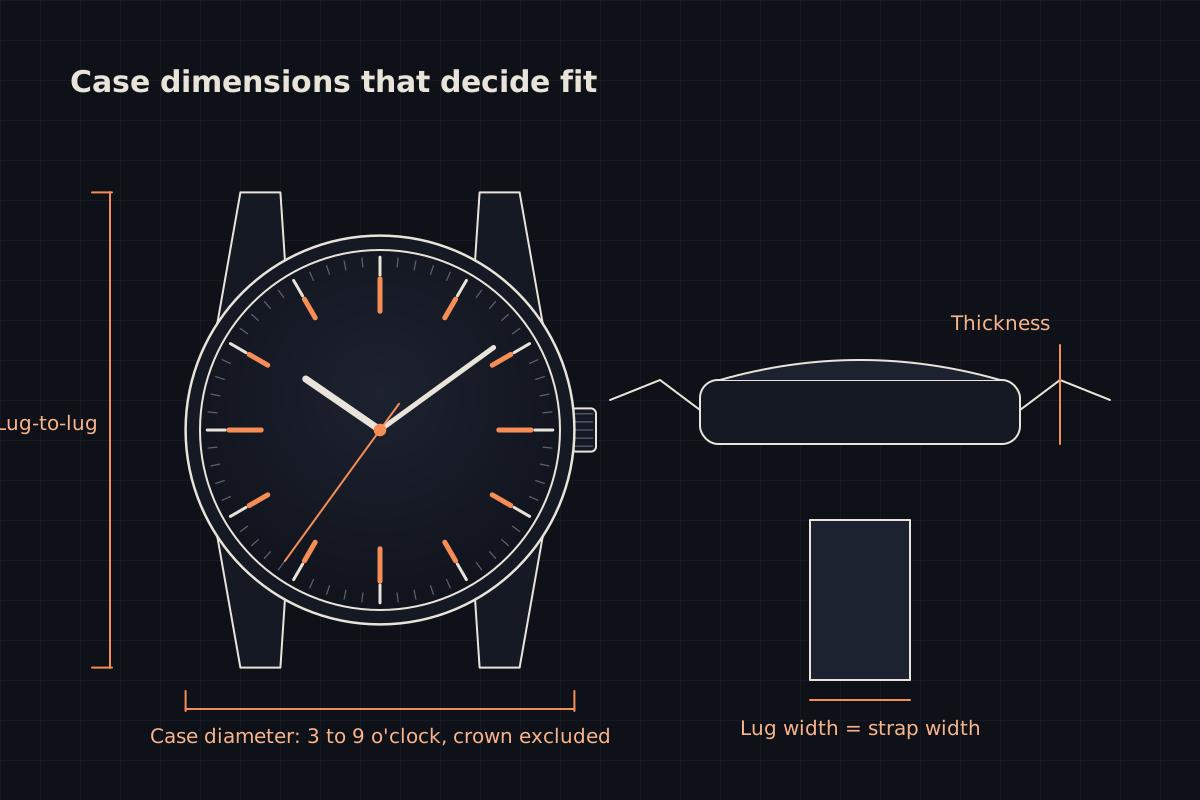
Learning how to measure wrist size for watches is only half the job, because you also need to read the case numbers. Case diameter is the figure you see first in any listing, such as 36 mm, 40 mm or 42 mm. It runs straight across the case from the 3 o'clock side to the 9 o'clock side. However, it leaves out the crown, so a 40 mm watch is a touch wider in real life. If you check a watch with a calliper, skip the crown too.
Diameter is useful, but it is only one number. In fact, two watches with the same diameter can wear very differently. That comes down to the lugs, the bezel and even the dial colour. For example, a wide bezel makes a dial look smaller, whereas a thin bezel and a pale dial make it look larger. Wristler also notes that square cases tend to look bigger than round ones with the same figure, so 2 to 4 mm less often suits them. For terms such as bezel, crown and lugs, see our watch glossary.
Lug-to-lug: why it often matters more
Lug-to-lug is the distance from the tip of the top lugs to the tip of the bottom lugs. In other words, it is the full length of the watch head along your arm. So any advice on how to measure wrist size for watches should cover it. Jamais Vulgaire treats it as the number that decides the final fit. If the lugs reach past the edges of your wrist, the watch overhangs. As a result, it looks too big, even when the diameter seems right on paper.
Here is a common surprise. A 38 mm watch with long, straight lugs can measure 48 mm or more from tip to tip. Meanwhile, a 42 mm watch with short, curved lugs might come in at about 46 mm. So the "smaller" watch can overhang a slim wrist more than the larger one. That is why lug-to-lug is often a better guide than diameter alone, especially for vintage-style pieces and many dive designs.
A simple overhang check
The principle is simple: the lug-to-lug should not reach past the flat top of your wrist. So measure that flat top directly. Hold a ruler across the top of your wrist, from one side edge to the other, and note the width in millimetres. Then compare it with the lug-to-lug in the watch's specifications. If the lug-to-lug is the same or smaller, the lugs stay on your wrist. This step is the piece most advice on how to measure wrist size for watch buyers leaves out.
Jamais Vulgaire takes the same view and adds that a lug-to-lug of about 75 to 95 per cent of that width tends to look balanced. For instance, if your wrist measures 54 mm across, a lug-to-lug of roughly 41 to 51 mm should sit comfortably. Without a ruler, you can get a rough estimate by dividing your circumference in millimetres by 3.14, although a direct measurement is more reliable because wrists are oval, not round.
Thickness and how a watch sits under a cuff
Thickness is the height of the case from the back to the top of the crystal. Advice on how to measure wrist size for watches often skips it, yet it changes comfort more than most people expect. A slim dress watch slides under a shirt cuff, whereas a chunky dive watch sits on top of it. Jamais Vulgaire gives rough bands: about 6 to 9 mm for dress watches, 9 to 12 mm for everyday pieces and 14 mm or more for many dive models. Also, a tall case on a small wrist can wobble and catch on door frames. If you wear long sleeves to work, check this number as closely as the diameter.
Lug width and strap width
Lug width is the gap between the lugs where the strap fits, such as 18, 20 or 22 mm. It is not the same as case size, but it still shapes the look. A wide strap makes a watch feel sportier and heavier, while a narrow, tapered strap looks dressier. When you buy a new watch strap, its width at the lugs must match the lug width exactly. Otherwise, it will rattle or simply not fit. Bracelet length matters too, since most steel bracelets arrive long and need links removed. In short, strap fit is the last detail in how to measure wrist size for watch comfort.
Chart: match your wrist measure to a watch size
If you already know how to measure wrist size for watch buying, this chart turns that number into a shortlist. It pairs the Wristler rule of thumb with the typical bands published by Wristcheck. Wristcheck, for example, suggests about 34 to 43 mm for wrists of 15 to 18 cm, and about 42 to 46 mm for 19 to 25 cm. Print it, add your own number and take it with you when you try watches on.
| Wrist circumference | Rule of thumb (cm × 2.3) | Typical range |
|---|---|---|
| 15 cm (5.9 in) | about 35 mm | 34–43 mm |
| 16 cm (6.3 in) | about 37 mm | 34–43 mm |
| 17 cm (6.7 in) | about 39 mm | 34–43 mm |
| 18 cm (7.1 in) | about 41 mm | 34–43 mm |
| 19 cm (7.5 in) | about 44 mm | 42–46 mm |
| 20 cm (7.9 in) | about 46 mm | 42–46 mm |
If you are still unsure, start with 38 to 42 mm. That range suits an average wrist of about 7 to 7.5 inches, according to several retailer guides. Also, remember that the ranges are wide on purpose, because style and comfort still decide the final pick. Whatever the diameter, check that the lug-to-lug stays within the flat top of your wrist.
Rule of thumb: turn your wrist measure into a watch size
For a quick answer, multiply your wrist circumference in centimetres by 2.3. The result is a sensible starting diameter in millimetres. So an 18 cm wrist gives about 41 mm, while a 16 cm wrist gives about 37 mm. This shortcut comes from Wristler, and it lines up well with the chart. It is also the fastest way to use what you now know about how to measure wrist size for watches.
Second Movement offers a related method. First, convert your wrist to millimetres and divide by three to estimate the flat top. Then aim for a case of about 60 to 75 per cent of that width. Similarly, Demesy groups wrists into small, medium, large and extra large bands. All three approaches point in the same direction, so pick the one you find easiest.
Tips for slim and large wrists
If your wrist is under 16 cm, knowing how to measure wrist size for watches helps you avoid cases that overhang. Look for short or curved lugs, a thin case and a slim bezel. In addition, a 36 mm or smaller dress watch can look elegant rather than tiny. Many classic designs were sized this way for decades, so you have plenty of choice.
On the other hand, large wrists of 19 cm or more can carry 42 to 46 mm comfortably. The same rules on how to measure wrist size for watches still apply. Even so, very thick cases can feel top-heavy. A wide bracelet or a 22 mm strap usually balances a bigger head better than a thin strap. In the end, proportion matters more than any single number.
Common mistakes when you measure wrist size for a watch
- Measuring over the wrist bone instead of just above it, which adds a few millimetres.
- Pulling the tape tight, so the reading comes out too small.
- Judging by diameter alone rather than checking lug-to-lug as well.
- Forgetting thickness, especially if you wear long sleeves every day.
- Copying a friend's size, even though wrist shapes vary a lot.
Strap choice also changes how a case wears. A steel bracelet adds visual weight, while a slim leather strap can make the same watch look smaller. That said, once you know how to measure wrist size for watch fitting, you can test these effects with a clear head. For tips on placement and tightness, read our guide on how to wear a watch.
Trying a watch on before you buy
Even when you know how to measure wrist size for watches, a try-on settles it. When you visit a shop, wear the watch where you normally would, just above the wrist bone. Then look at it in a mirror from about an arm's length, because that is how other people see it. Also check that the lugs stay inside the edges of your wrist. If you shop online, compare the listed numbers with a watch you already own and like. In fact, that side-by-side check is often the most reliable test of all.
Recap: measure your wrist, then check three watch size numbers
To sum up, here is how to measure wrist size for watch shopping in one breath. First, wrap a tape just above the wrist bone and note the result in millimetres. Next, multiply the centimetre figure by 2.3 for a starting diameter. Then measure the flat top of your wrist across and keep the lug-to-lug within that width. Finally, check the thickness against your sleeves and match the strap to the lug width.
Frequently asked questions
How do I measure my wrist size for a watch?
Wrap a soft tape measure around your wrist just above the wrist bone, keeping it flat and snug without pressing into the skin. Read the number where the tape overlaps. If you have no tape, use a strip of paper or string, mark the overlap with a pen and lay it against a ruler.
What size watch should I get for my wrist?
A simple starting point is to multiply your wrist circumference in centimetres by 2.3, so an 18 cm wrist suggests about 41 mm. Wrists of 15 to 18 cm usually suit about 34 to 43 mm, while 19 to 25 cm wrists can take about 42 to 46 mm. Then check the lug-to-lug.
What is lug-to-lug on a watch?
Lug-to-lug is the distance from the tip of the top lugs to the tip of the bottom lugs, so it is the full length of the watch head along your arm. It often matters more than diameter, because long lugs can overhang a slim wrist even when the case diameter looks modest on paper.
How do you measure watch case size?
Measure the case diameter straight across from the 3 o'clock side to the 9 o'clock side, leaving out the crown. Brands quote case size this way. For a full picture, also note the lug-to-lug length, the thickness from case back to crystal and the lug width where the strap attaches.
Is a 40 mm watch too big for a small wrist?
Not always. A 40 mm case with short, curved lugs can sit neatly on a wrist of about 16 cm. However, if its lug-to-lug is longer than the flat top of your wrist, it will overhang. Measure the flat top of your wrist across with a ruler, in millimetres, and compare it with the lug-to-lug.
Sources
- Wristcheck: Size guide, how to pick the perfect fit for your wrist
- Wristler: Watch size and wrist
- Demesy: Watch sizing guide
- Jamais Vulgaire: What size watch according to your wrist, the real calculation
- Second Movement: Guide to choosing the right watch size for your wrist
- Watch.co.uk: How do you measure your watch size?
Prices, specifications and availability change. Check the brand's official Malaysian site or an authorised retailer before you buy.