
Quartz Watch: How It Works, Accuracy and Care
Everything you need to know about the battery-powered movement inside most of the world's watches.
Key takeaways
- A quartz watch uses a battery, a circuit and a tiny crystal vibrating 32,768 times per second.
- A standard quartz movement typically drifts about 15 seconds a month; high-accuracy models manage about ±5 to ±10 seconds a year.
- Solar (such as Citizen Eco-Drive) and kinetic versions recharge themselves, so you rarely need a new battery.
- The seconds hand ticks once a second because the motor moves in single steps to save power.
- Quartz can be luxury: Grand Seiko's 9F calibre is a hand-assembled, high-accuracy example.
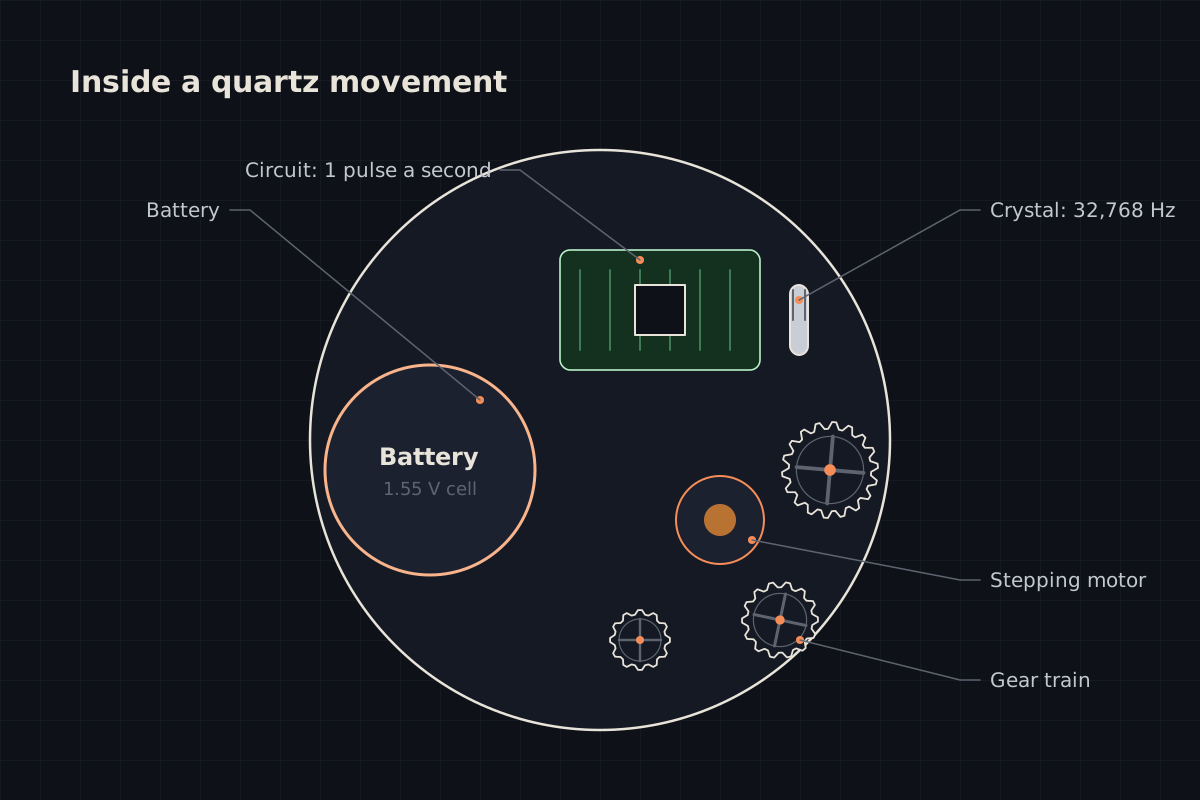
A quartz watch keeps time with a battery, a tiny circuit and a sliver of vibrating crystal. As a result, it is cheap to make, very accurate and easy to live with. Today, most watches sold around the world run on quartz. This guide explains how the movement works, how accurate it is, which variants exist and how to care for one.
What is a quartz watch?
Put simply, it is a watch whose speed is set by a quartz crystal rather than a swinging balance wheel. The crystal acts like a very fast, very steady metronome. Meanwhile, a battery supplies the energy, and a small motor turns that steady beat into moving hands or a digital display. So there is no spring to wind and very little to wear out.
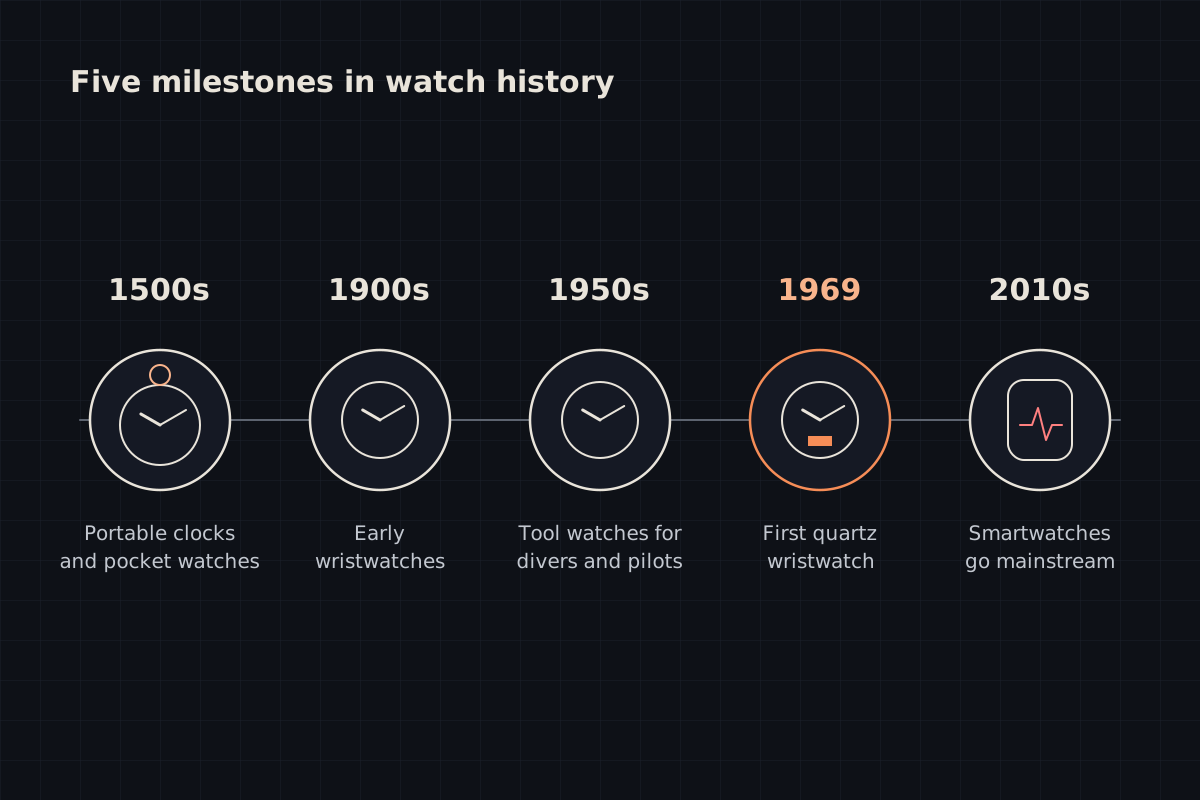
Quartz timekeeping is older than most people think. In fact, Bell Labs built the first quartz clock in 1927. Then, on 25 December 1969, Seiko launched the Astron, the first quartz wristwatch. It cost ¥450,000 at the time, about the price of a small car. Within a decade, prices fell sharply, and the resulting upheaval for Swiss makers became known as the quartz crisis.
How a quartz watch works
The movement follows a simple chain of four steps. Each step hands its job to the next, and together they turn stored electricity into steady time. Below, you can follow the path from the battery to the hands.
- Battery: a small button cell supplies a steady electric current to the circuit.
- Circuit: the integrated circuit sends that current through the crystal and counts its vibrations.
- Crystal: a tuning-fork shaped quartz crystal vibrates exactly 32,768 times per second.
- Stepping motor: once every second, the circuit sends a pulse that turns a tiny motor, which then drives the gears and hands.
Why 32,768? That number is two to the power of 15. Because of this, the circuit can halve it 15 times in a row to get exactly one pulse per second. The frequency is also just above the range of human hearing, yet low enough to keep power use small. In other words, engineers chose it as a neat compromise.
Why quartz vibrates
Quartz is piezoelectric. That means it bends slightly when an electric current passes through it, and it produces a small voltage when it flexes. Cut to the right shape, the crystal settles into a very stable vibration. The circuit then reads that vibration and keeps it going. For this reason, quartz makes such a dependable timing source.
How accurate is a quartz watch?
A standard quartz watch typically gains or loses about 15 seconds a month. That works out to roughly three minutes a year, so you might only need to adjust it twice a year. By comparison, a good mechanical watch may drift around 5 seconds in a single day. As a result, even an inexpensive quartz model usually beats a costly automatic on raw accuracy.
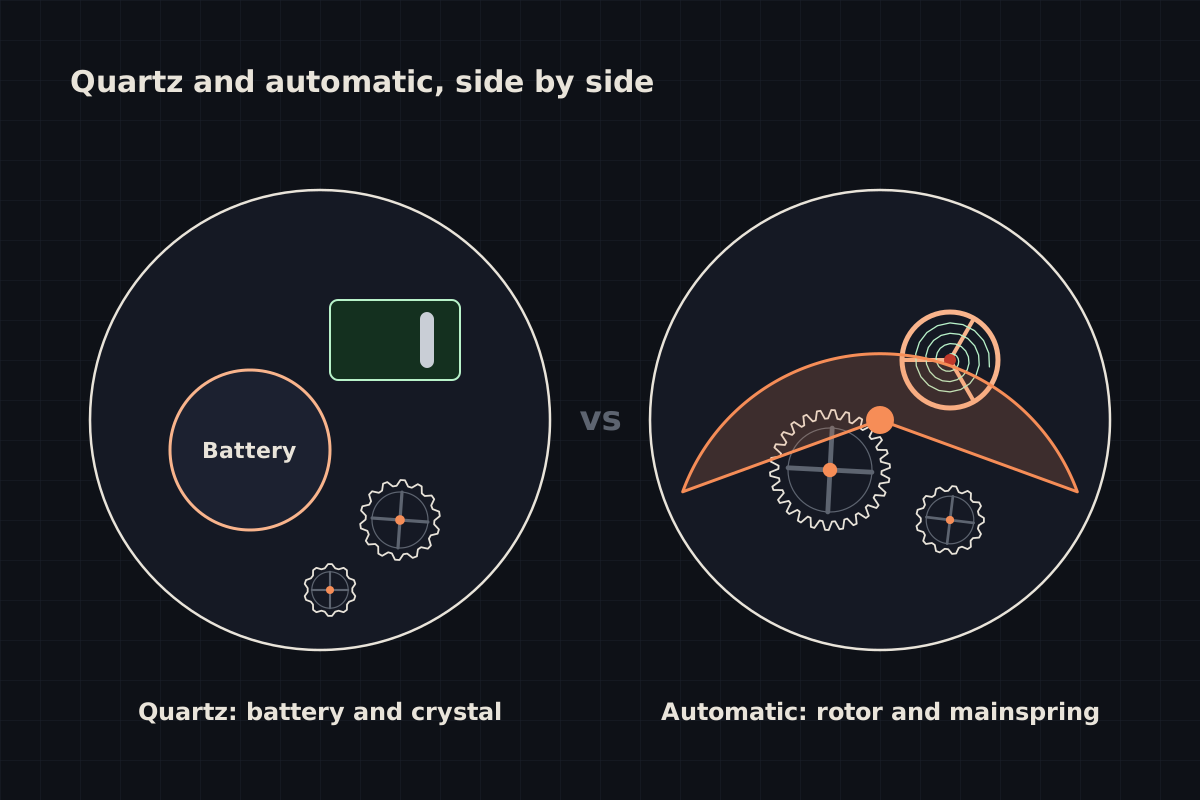
Temperature is the main enemy. A quartz crystal vibrates a little faster or slower as it warms or cools. Because your wrist keeps the watch close to body temperature, everyday accuracy is usually good. However, leaving it on a hot car dashboard or in a cold room can shift the rate slightly. If you want a full side-by-side comparison, read our guide on quartz vs automatic watch movements.
High-accuracy quartz watch movements
Some makers push quartz much further. They usually do this by measuring the temperature and correcting the crystal's rate in real time. For example, Grand Seiko says its 9F calibre samples the temperature 540 times a day. Thanks to this, it rates the movement to about ±10 seconds a year, rather than per month.
Citizen goes further still. Its Chronomaster and The CITIZEN high-accuracy models reach about ±5 seconds a year. To achieve this, Citizen ages its crystals and observes them for six months, then keeps only the ones that meet the standard. Bulova took another route with its Precisionist line, which uses a crystal vibrating at about 262 kHz, eight times the normal rate.
Solar and kinetic quartz watch types
A normal battery eventually runs flat. Therefore, several brands have built quartz models that recharge themselves. The two best-known systems use light and motion. Both still keep quartz-level accuracy, but they avoid the routine battery change.
Solar: Citizen Eco-Drive
Citizen released the world's first light-powered analogue watch in 1976. Today, its Eco-Drive system places a solar cell under the dial. The cell turns any light, from sunshine to an office lamp, into power. Then a rechargeable cell stores that energy. Citizen says many models run for more than six months on a full charge, and some last far longer.
Kinetic: motion-powered quartz
Seiko launched its AGS system in 1988 and renamed it Kinetic in 1997. Like an automatic, it has a swinging rotor. However, the rotor spins a tiny generator instead of winding a spring. That generator charges a cell, which then powers the quartz circuit. So you get automatic-style winding with quartz accuracy, although you still need to wear it fairly often.
Why the seconds hand ticks
On most quartz models, the seconds hand jumps once every second. This happens because the circuit sends just one pulse per second to the stepping motor. Each pulse moves the hand forward by one mark. Moving in single steps also saves a great deal of battery power, so the cell lasts for years.
By contrast, an automatic watch moves its hand in many tiny steps each second, which looks like a smooth sweep. Some quartz designs change the motion, too. For instance, Grand Seiko's 9F uses a backlash auto-adjust mechanism, so the hand lands on each marker without shuddering. Meanwhile, Seiko's Spring Drive uses a mainspring with quartz control, and its hand glides with no ticks at all.
Quartz watch battery life
Most batteries last between two and five years. The exact figure depends on the movement, the size of the cell and the features you use. For example, chronograph timers, alarms and backlights all drain power faster. Many models also have an end-of-life warning, where the seconds hand starts jumping in two-second steps. When you see that, plan a watch battery replacement soon.
Can a quartz watch be luxury?
Yes, although it is less common at the top end. The clearest example is Grand Seiko's 9F calibre. Grand Seiko assembles it entirely by hand and fits a twin pulse control motor, which gives enough torque to drive its large, heavy hands. On top of that, the backlash auto-adjust mechanism stops the seconds hand from wobbling. You can read the full specification on Grand Seiko's 9F62 page.
Citizen's high-accuracy line sits in a similar space. Beyond these, many fashion and jewellery-led brands use quartz in slim dress watches, because a thin quartz movement allows a very elegant case. That said, most collectors still prefer mechanical craft for investment pieces. So if resale value matters to you, weigh that before you buy.
Caring for a quartz watch
Quartz is low maintenance, but not no maintenance. First, change the battery on time and keep the seals in good shape. Then avoid big temperature swings and hard knocks. Also, keep the crown pushed in fully, because an open crown can let in moisture. Finally, if the watch has water resistance, have it pressure tested after each battery change.
Is a quartz watch right for you?
A quartz model suits you if you want accurate time, low running costs and no fuss. It is also ideal if you rotate several watches, because it keeps running in the drawer. On the other hand, if you love craft and the idea of a living mechanism, a mechanical piece may suit you better. Either way, now you know exactly what is ticking inside.
Frequently asked questions
What is a quartz watch?
It is a watch that keeps time using a small quartz crystal and a battery. The battery sends current through the crystal, which vibrates 32,768 times per second. A circuit counts these vibrations and sends one pulse each second to a tiny motor, which then moves the hands. The result is cheap, accurate timekeeping.
How long does a quartz battery last?
Most quartz batteries last around two to five years, depending on the movement and features. Chronographs, alarms and lights drain power faster. Solar models such as Citizen Eco-Drive store light in a rechargeable cell and rarely need a change. Replace a dead battery promptly, because an old cell can leak and damage the movement.
Is quartz better than automatic?
Quartz is better for accuracy, low cost and convenience. It drifts about 15 seconds a month, while an automatic may drift a few seconds a day. An automatic is better if you value craft, a sweeping seconds hand and long-term repairability. The right choice depends on what matters most to you as an owner.
Why does my quartz watch tick?
The circuit sends one electrical pulse per second to a tiny stepping motor. Each pulse moves the motor, and so the seconds hand, forward by one step. Moving once a second saves battery power. Some models, such as Grand Seiko 9F or Spring Drive, use special engineering to make the hand land or glide differently.
Can a quartz watch be luxury?
Yes. Grand Seiko's 9F calibre is a hand-assembled quartz movement rated to about ±10 seconds a year, with features to stop the seconds hand from shuddering. Citizen's Chronomaster line reaches about ±5 seconds a year. Several luxury houses also sell quartz versions of their dress watches, especially in smaller sizes.
Sources
- Wikipedia: Quartz clock
- Wikipedia: Quartz crisis
- Grand Seiko: Quartz movements (Calibre 9F)
- Citizen: Eco-Drive technology
- Citizen: The CITIZEN annual accuracy ±5 seconds
- Epson: Seiko AGS, the first automatic generating quartz watch (1988)
- Bulova: Watch movement types explained
- Bob's Watches: Quartz vs automatic movement
Prices, specifications and availability change. Check the brand's official Malaysian site or an authorised retailer before you buy.