
Vintage Watch Guide: How to Buy, Wear and Care for One
How to judge an old watch before you buy it, how to wear a pocket watch properly, and how to keep a decades-old movement running.
Key takeaways
- A vintage watch is usually taken to mean one more than about 30 years old, but that cut-off is a collector convention, not a rule.
- Originality matters most: an unpolished case, original dial and hands, and matching parts carry more value than shine.
- Watch for redials, replaced lume and heavy polishing, and ask for service records.
- Wear a pocket watch on an Albert chain fixed through a waistcoat buttonhole with a T-bar, or clipped to a belt loop.
- Treat any old watch as not water resistant until a watchmaker has pressure-tested it.
A vintage watch is an older timepiece, usually about 30 years old or more. People buy one for its design, history and craft. It might be a 1960s dive watch, a slim 1950s dress watch or a family pocket watch. Because every old watch has lived a different life, buying one takes more care than buying new. This guide shows you what to check, how to wear a pocket watch and how to keep an old movement healthy.
What counts as a vintage watch?
There is no official definition. In practice, most dealers and collectors call a watch vintage once it reaches about 30 years old, although some use 20 or 25 years. So treat the number as a convention, not a rule. According to Luxury Bazaar, watches roughly 12 to 35 years old are often called "neo-vintage". Pieces older than about 75 years tend to be called antique.
Age is only part of it, however. Materials also mark an era. For example, older watches often have acrylic crystals and radioactive lume, while modern ones use sapphire and non-radioactive lume. In other words, a vintage watch usually looks and feels different from a new one, not just older. If you want the wider story behind these changes, our guide to the history of watches covers each era.
Why people buy a vintage watch
People choose old watches for several reasons. First, many classic designs were smaller and slimmer than today's watches, which suits slim wrists well. Second, each piece has a story, whether it is a family heirloom or a model linked to a famous era. Finally, a good vintage watch can cost less than a new watch of similar quality. Rare pieces, however, can sell for far more. At the very top of the market, some old references now appear among the most expensive watch sales ever recorded.
Buying tips for a vintage watch
The golden rule is to buy the seller as much as the watch. A reputable dealer will describe faults honestly, show the movement and offer some form of return or warranty. In addition, ask as many questions as you need before you pay. The checks below cover the points that matter most.
Originality comes first
Collectors value a watch that is as close as possible to how it left the factory. That means the original dial, hands, crown, bezel and case, with parts that match the model and year. For instance, a correct, slightly worn dial is usually worth more than a perfect replacement. Also, compare the watch with photos of confirmed examples of the same reference before you commit.
Redials and heavy polishing
A redial is a dial that has been repainted or refinished, often during an old service. It may look fresh, but it lowers value sharply. Warning signs include soft or uneven printing, the wrong font and lume that looks much newer than the hands. Similarly, check the case for over-polishing. Sharp edges and crisp bevels are good signs, whereas rounded, soft lines suggest the case has lost metal.
Patina and lume on a vintage watch
Patina is the natural ageing of a dial, hands and lume. Many buyers like it, because it proves the watch is genuinely old. That said, heavy damage, water marks or flaking paint are faults, not charm. Lume needs special care too. According to Worn & Wound and Wristcheck, radium lume was common from the 1910s to the early 1960s. Brands then switched to tritium. Then, in the late 1990s, non-radioactive Super-LumiNova took over. If a vintage watch may have radium lume, do not open it yourself, and leave any work to a qualified watchmaker.
Service history and papers
Ask when the watch was last serviced and by whom. Service papers, the original box and purchase documents all add confidence and value. However, a lack of papers is common with old watches, so judge the watch itself first. Also ask whether original parts were kept when anything was replaced.
The pocket watch
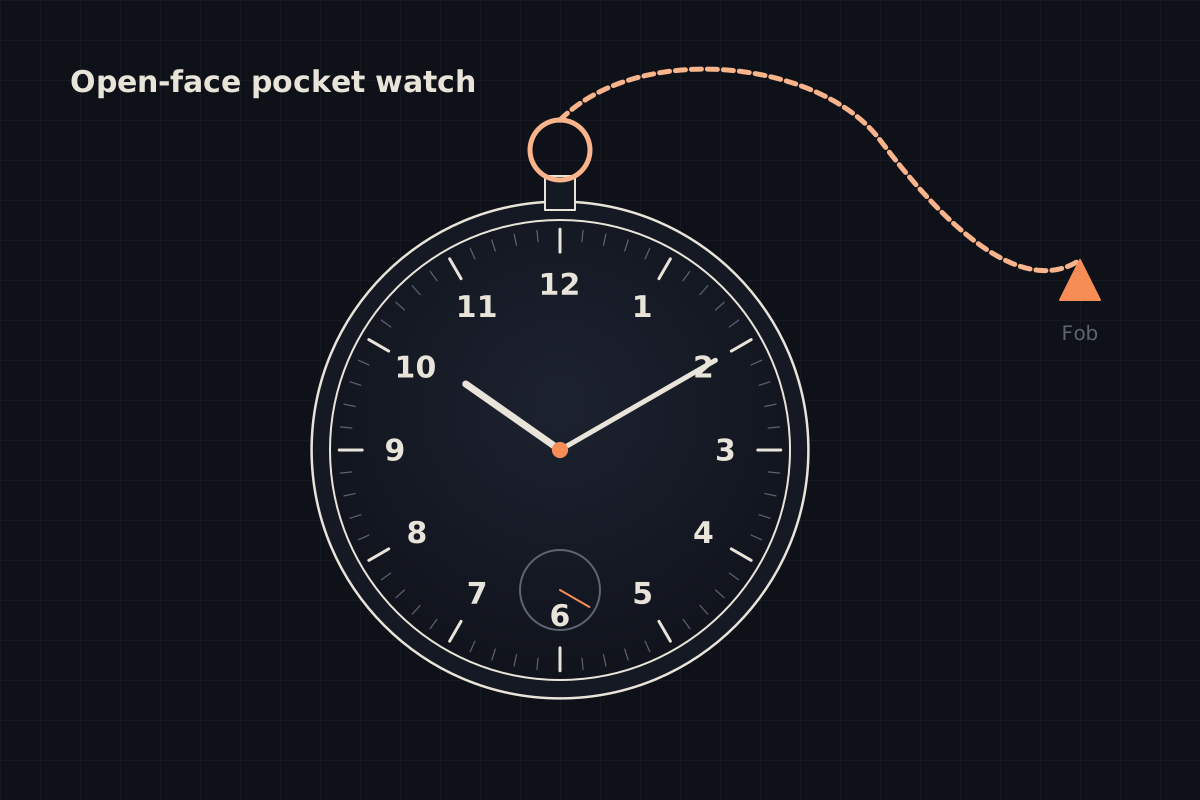
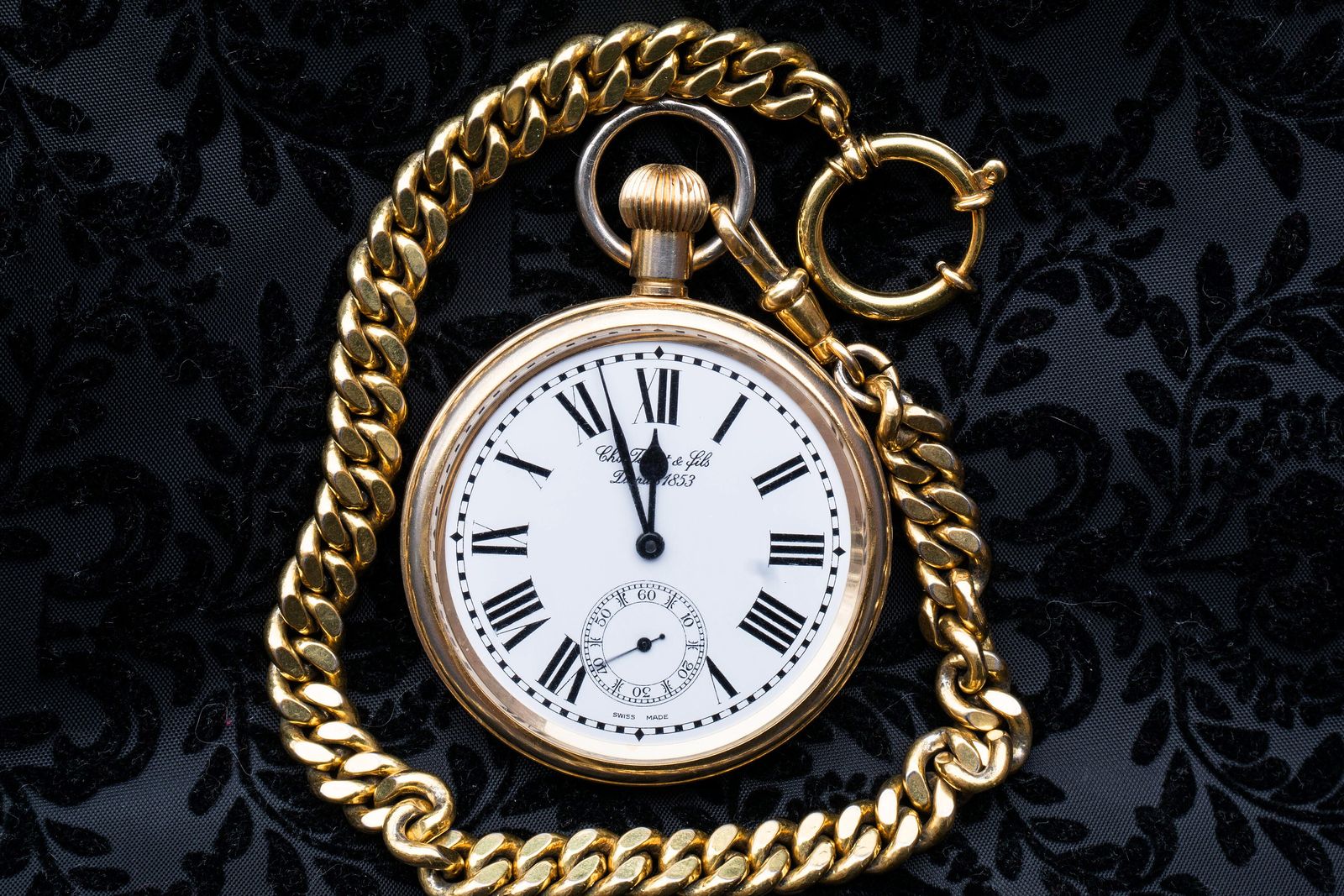
Before the wristwatch spread in the early 20th century, the pocket watch was the normal watch for men. According to Wikipedia, watches only became common in pockets in the 17th century, and they stayed dominant for roughly 300 years. Many surviving examples are hand-wound mechanical pieces, so they suit anyone who enjoys a daily ritual. Pocket watches come in two main styles. An open-face case shows the dial at all times, while a hunter case has a hinged lid that protects the crystal.
How to wear a pocket watch
The classic way is with a waistcoat. You fix the T-bar of an Albert chain through a waistcoat buttonhole, then place the watch in one of the lower pockets. A double Albert has two chains. One end holds the watch, and the other holds a fob (a small charm or weight) in the opposite pocket. As a result, the chain hangs in a neat curve across the front.
- With a waistcoat: T-bar through a buttonhole, watch in a waistcoat pocket.
- Without a waistcoat: clip a short chain to a trouser belt loop and keep the watch in your front pocket.
- With a jacket only: some people clip the chain through the lapel and use the breast pocket, although it is less secure.
Above all, keep the chain short enough that the watch cannot swing out and hit anything. Also match the chain's metal to the case for a tidy look.
Caring for a vintage watch
An old movement needs gentle handling. Wind a hand-wound watch at roughly the same time each day, and stop as soon as you feel resistance. In addition, avoid knocks, strong magnets and sudden temperature changes. Store the watch in a dry place, because damp air harms old dials and movements.
A vintage watch on a strap also deserves a strap that suits its age and size. Old lug widths are often narrow, such as 18 mm or less, so check before you order. Our guide to the watch strap options covers sizes and materials.
Servicing a vintage watch
Old oils dry out, and worn parts can damage others if the watch keeps running. Therefore, it makes sense to have a watchmaker inspect any vintage watch soon after you buy it. Choose someone experienced with older calibres, and ask them to keep original parts and return any they replace. For a branded watch, the maker's official service centre may be an option. Our list of service centres in Malaysia is a good place to start. If your old watch is quartz, read our guide to watch battery replacement first. A leaking battery can damage the movement.
Many vintage pieces are hand-wound or early automatics. To understand what sits inside, our guide to the mechanical watch explains the mainspring, gear train and balance wheel in plain terms.
Vintage watch water resistance caveats
Here is the most important safety rule: treat every old watch as not water resistant. Rubber gaskets seal the crown, case back and crystal, but they dry out and harden with age. According to WatchGecko, gaskets can degrade within a few years, depending on use and climate. So even a vintage dive watch that once handled great depths may now let in moisture. In Malaysia's heat and humidity, that risk deserves extra care.
If you want to wear a vintage watch near water, ask a watchmaker to replace the seals and pressure-test it first. Even then, avoid hot showers, saunas and swimming pools with older pieces. For a clear explanation of what ratings actually mean, read our guide to water resistance.
Is a vintage watch right for you?
A vintage watch suits you if you enjoy history, accept small imperfections and are happy to care for a delicate object. On the other hand, a modern piece may suit you better for the pool, the gym or carefree daily wear. Either way, take your time, ask questions and buy from a seller you trust. That approach will help you find an old watch you will enjoy for decades.
Frequently asked questions
How old does a watch have to be to be vintage?
Most collectors and dealers call a watch vintage once it is about 30 years old, although some use 20 or 25 years. There is no official standard. Watches roughly 12 to 35 years old are often called neo-vintage, and pieces over about 75 to 100 years old are usually described as antique.
How do you wear a pocket watch?
The classic way is with a waistcoat. Fix the T-bar of an Albert chain through a buttonhole and put the watch in a waistcoat pocket, often on the opposite side. Without a waistcoat, clip a short chain to a trouser belt loop and keep the watch in your front pocket.
What is a redial on a vintage watch?
A redial is a dial that has been repainted or refinished, usually during an old service. It can look cleaner than an original dial, but collectors value it far less. Signs include blurred or uneven printing, fonts that do not match the model, and fresh-looking lume next to aged hands.
Can I swim with a vintage watch?
It is safest not to. Rubber gaskets dry out and harden over the years, so an old watch may no longer keep water out, whatever its original rating. If you want to wear one near water, ask a watchmaker to replace the seals and pressure-test it first, and repeat the test regularly.
How often should a vintage watch be serviced?
There is no fixed rule, but many watchmakers suggest a service every five years or so for a mechanical watch in regular use. For a vintage piece, start with an inspection when you buy it, because old oils dry out. Choose a watchmaker experienced with older calibres and ask them to keep original parts.
Sources
- Luxury Bazaar: What is considered a vintage watch nowadays?
- Time+Tide: Vintage watch terms glossary
- Wristcheck: The story of early watch lume
- Worn & Wound: Seeing in the dark, luminescence in watches
- The Irreverent Gent: How to wear a pocket watch
- WatchGecko: What is water resistance? Is my watch waterproof?
- Wikipedia: Watch (history section)
Prices, specifications and availability change. Check the brand's official Malaysian site or an authorised retailer before you buy.