
Swiss Watch Brands: Swiss Made Rules, COSC and Who Owns Whom
What the Swiss Made label legally means, how chronometers are tested, and which group stands behind each famous name.
Key takeaways
- Since 1 January 2017, a Swiss Made watch needs at least 60% of its manufacturing costs in Switzerland and a Swiss movement.
- COSC tests movements for 15 days in five positions and at three temperatures; mechanical ones must average −4 to +6 seconds a day.
- Three groups, Swatch Group, Richemont and LVMH, own many famous names, while Rolex, Patek Philippe and Audemars Piguet stay independent.
- Swiss brands span every budget, from Swatch and Tissot to Patek Philippe and Vacheron Constantin.
- Buy from an authorised dealer in Malaysia to get the full international warranty and genuine service.
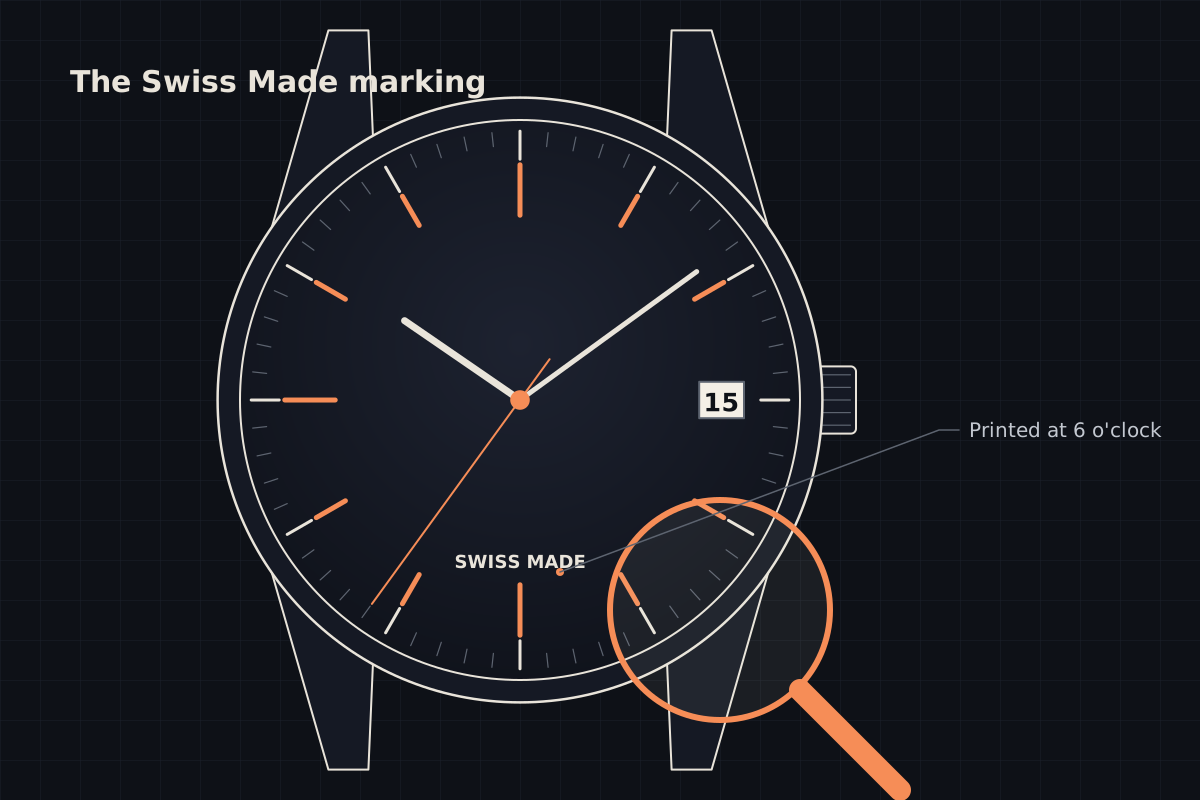
Swiss watch brands still set the standard that the rest of the industry measures itself against. Yet the words "Swiss Made" on a dial are not just marketing. They are a legal claim with clear rules behind them. This guide explains those rules, how chronometer testing works, which groups own the big names, and which brands suit each budget, so you can shop with confidence in Malaysia.
What counts as Swiss watch brands
A Swiss brand is simply one based in Switzerland, but its watches only carry "Swiss Made" if they meet the law. In fact, some well-known Swiss watch brands began elsewhere. Hamilton, for example, started in Lancaster, Pennsylvania in 1892 and moved all production to Switzerland after it closed its American factory in 1969. Similarly, an American, Florentine Ariosto Jones, set up IWC in Schaffhausen in 1868.
So the brand's address matters less than where and how each watch is made. That is why the Swiss government protects the label so carefully, and why you should know what it covers before you pay a premium for it.
The Swiss Made rules for Swiss watch brands
The rules sit in a federal ordinance on the use of "Switzerland" or "Swiss" for watches. The current, stricter version took effect on 1 January 2017. Before then, only the movement counted towards the Swiss value. Now the whole watch counts, including research and development costs.
Rules for the whole watch
According to the Swiss watch ordinance, a watch may carry the Swiss Made label only when all of these points apply:
- its technical development takes place in Switzerland;
- its movement is Swiss;
- the movement goes into the case in Switzerland;
- the maker carries out the final inspection in Switzerland; and
- at least 60% of the manufacturing costs arise in Switzerland.
Rules for a Swiss movement
The movement has its own test. It must be assembled and inspected by the maker in Switzerland, and its technical development must happen there too. For a mechanical calibre, that means the construction and the prototypes. For an electronic one, it also covers circuit design, display design and software. On top of that, at least 60% of the movement's manufacturing costs must arise in Switzerland. Swiss-made parts must also make up at least half of the value of all its parts, not counting assembly.
COSC chronometer certification
"Chronometer" on a Swiss dial usually means a pass from COSC, the Swiss Official Chronometer Testing Institute. This non-profit body took its current form in 1973 and runs laboratories in Biel/Bienne, Saint-Imier and Le Locle. According to COSC, each uncased movement runs for 15 days, in five positions and at three temperatures: 8°C, 23°C and 38°C.
To pass, a mechanical movement must average between −4 and +6 seconds a day, along with other strict limits. That is far tighter than a typical automatic, which may drift by around five seconds a day. As a result, COSC issues over a million certificates every year, and Rolex is among its largest users. Some brands then add their own tests on the finished watch. OMEGA's Master Chronometer label, for instance, adds testing for magnetism and accuracy after casing.
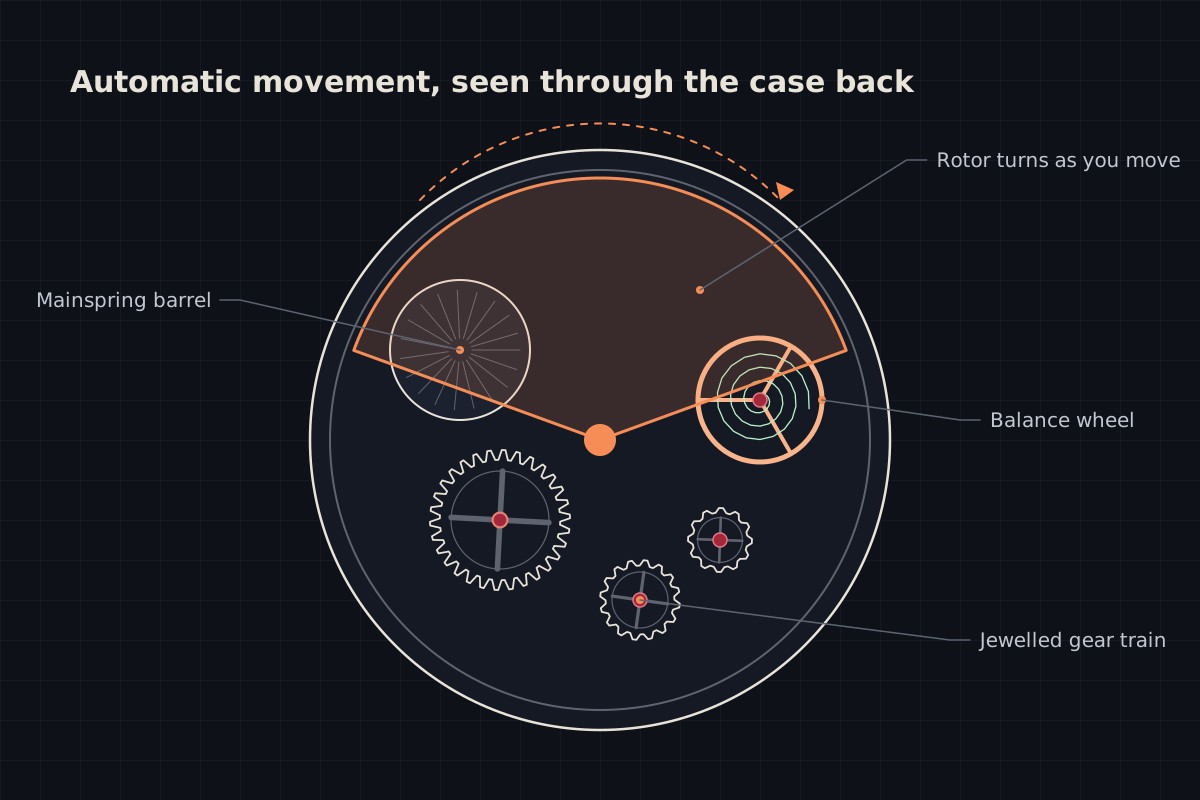
If you want to understand the engine behind most chronometers, our guide to the automatic watch explains how a swinging rotor winds the mainspring as you move.
How the quartz crisis reshaped Swiss watch brands
Swiss dominance was not always secure. In 1969, Seiko launched the Astron, the first quartz wristwatch. Swiss engineers had also built quartz movements, such as the Beta 21 shown at the 1970 Basel Fair, but cheaper Japanese quartz watches soon flooded the market. During the quartz crisis that followed, many Swiss watch brands closed or shrank.
Then came a rescue. In 1983, two struggling groups, ASUAG and SSIH, merged, and the same year the plastic Swatch arrived to win back the mass market. After Nicolas Hayek took control in 1985, the business became SMH in 1986 and the Swatch Group in 1998. Meanwhile, the high end turned mechanical watches into objects of craft and status, which is the role they still play today.
The groups behind Swiss watch brands
Many Swiss watch brands sit inside three large groups. Because of this, sister brands often share movement makers, case suppliers and service centres. Here is the current line-up, based on each group's own brand pages.
Swatch Group
The Swatch Group, based in Biel/Bienne, calls itself the world's largest maker of finished watches. Its watch and jewellery brands include Breguet, Harry Winston, Blancpain, Glashütte Original, Jaquet Droz, OMEGA, Longines, Rado, Union Glashütte, Tissot, Balmain, Certina, Mido, Hamilton, Swatch and Flik Flak. It also owns ETA, which supplies movements across the industry.
Richemont
Richemont lists seven specialist watchmakers: A. Lange & Söhne, IWC Schaffhausen, Jaeger-LeCoultre, Panerai, Piaget, Roger Dubuis and Vacheron Constantin. In addition, Cartier sits in its jewellery division, and Montblanc, which also makes watches, sits with fashion and accessories.
LVMH
The French luxury group LVMH owns TAG Heuer, Hublot and Zenith, alongside Bvlgari and smaller watch names such as Daniel Roth, Gérald Genta and L'Epée 1839.
Independent Swiss watch brands
Several of the strongest Swiss watch brands have no group parent. Rolex and Tudor belong to the Hans Wilsdorf Foundation. Patek Philippe has been with the Stern family since 1932, while Audemars Piguet is still family-owned. Richard Mille, Chopard and Oris are independent too. Breitling, by contrast, is private but controlled by investors led by Partners Group.
Swiss watch brands by price band
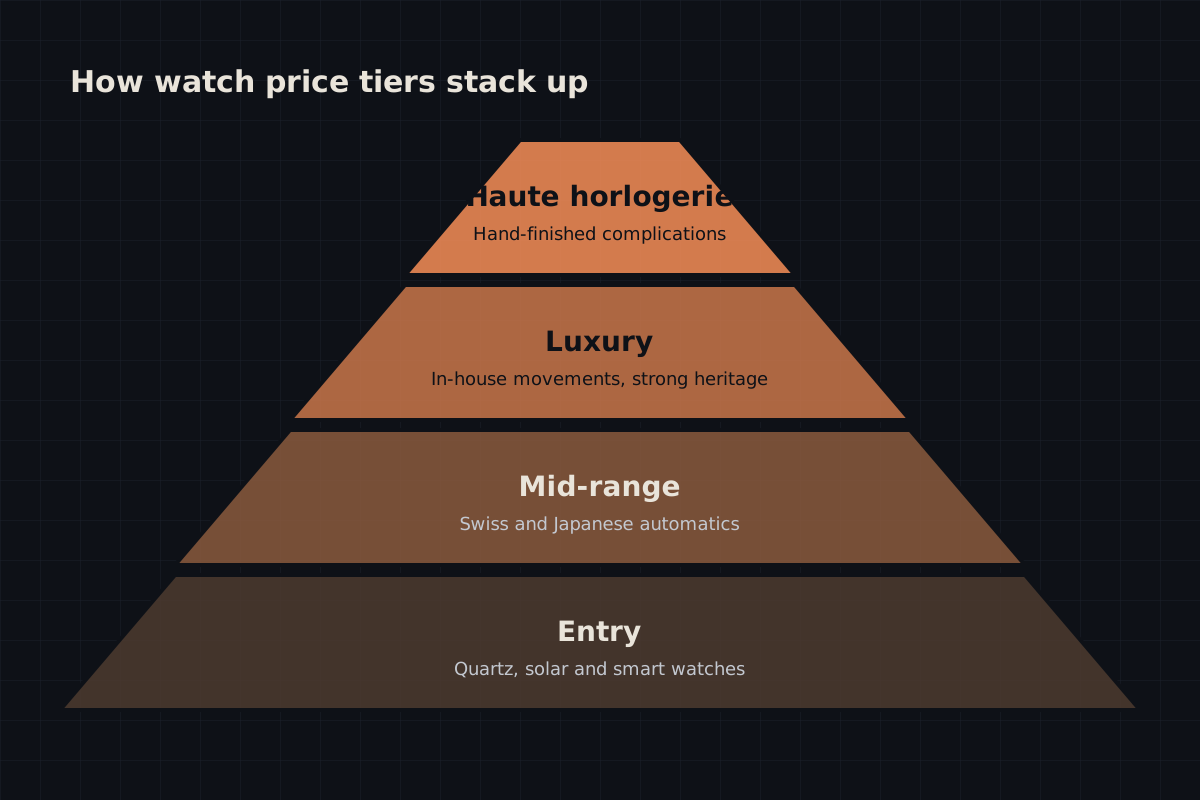
Swiss watch brands cover almost every budget. Rather than quote ringgit prices, which change often, here is how the main names sit relative to one another. For a deeper look at the top end, see our guide to luxury watch brands.
Accessible Swiss
Swatch, Tissot, Hamilton, Certina and Mido are the usual first step. Tissot, which dates from 1853 in Le Locle, makes the PRX, the Seastar and the Le Locle. Hamilton's Khaki Field and Khaki Aviation draw on its American military past, whereas Mido offers the Ocean Star and the Multifort. Many of them use movements from ETA, the Swatch Group's own movement maker.
Mid-range and entry luxury
Next come Longines, Rado, Oris, TAG Heuer and Tudor. Here you get better finishing, more in-house movements and stronger heritage. For instance, Rado is known for scratch-resistant ceramic in lines such as the Captain Cook and the True Square, while Oris makes only mechanical watches, such as the Aquis and the Big Crown.
Luxury and haute horlogerie
At the top sit Rolex, OMEGA, Breitling, IWC and Jaeger-LeCoultre, and above them Patek Philippe, Audemars Piguet, Vacheron Constantin, Breguet, Blancpain and Richard Mille. These houses make complicated movements, finish parts by hand and keep long service records. Of course, they also carry the longest waiting lists.
Why Swiss watch brands cost more
A Swiss watch usually costs more than a similar-looking watch from elsewhere. Part of the reason is simple cost, because the law requires most of the work and spending to stay in Switzerland, where skilled watchmakers and workshops are expensive. However, the bigger reason is the way the best houses work. They design their own movements, test them for weeks and finish many parts by hand, even parts you will never see.
Brand value plays a role too. Swiss watch brands spend heavily on boutiques, sponsorship and long service networks, and buyers pay for that history. On the other hand, a Swiss label does not always mean better timekeeping. A good quartz watch from any country will beat most mechanical watches for accuracy. So you are mainly paying for craft, durability and design.
If that craft appeals to you, a mechanical watch is where Swiss makers shine brightest. In short, choose Swiss for the engineering story and the long-term support, not because the label alone guarantees a better watch. Then compare models within your budget, read the movement specification and, above all, try the watch on your wrist before you decide.
Buying Swiss watch brands in Malaysia
Most Swiss watch brands sell in Malaysia through official boutiques and authorised dealers. Buying there means you get the full international warranty, genuine papers and access to the brand's service network. If you want a wider view of what Malaysians buy, including Japanese and smart watch options, see our list of top watch brands in malaysia.
Finally, be careful with the label itself. Fakes often print "Swiss Made" on watches that have nothing Swiss inside. So check the serial number, ask for the warranty card, and buy from a seller the brand itself lists. That way, the Swiss promise on the dial is one you can trust.
Frequently asked questions
What does Swiss Made mean on a watch?
It means the watch meets the Swiss federal ordinance on watches. Its technical development happens in Switzerland, its movement is Swiss, it is cased up and finally inspected in Switzerland, and at least 60% of its manufacturing costs arise there. These stricter rules took effect on 1 January 2017.
What is a COSC chronometer?
A COSC chronometer is a watch whose movement passed testing at the Swiss Official Chronometer Testing Institute. Each movement runs for 15 days in five positions and at three temperatures. A mechanical movement must average between minus four and plus six seconds a day to earn the certificate.
Which Swiss watch brands are independent?
Rolex and Tudor, through the Hans Wilsdorf Foundation, are independent, as are Patek Philippe, Audemars Piguet, Richard Mille, Chopard and Oris. Breitling is privately owned by investors led by Partners Group. Most other famous names belong to the Swatch Group, Richemont or LVMH, which share resources across their brands.
What is the best affordable Swiss watch brand?
Tissot, Hamilton, Mido, Certina and Swatch are popular starting points because they offer Swiss quartz and automatic movements at accessible prices. Tissot's PRX and Hamilton's Khaki Field are common first Swiss watches. Above them, Longines, Oris and Tudor offer more finishing and heritage for a higher budget.
Is a Swiss movement watch the same as Swiss Made?
No. A dial that says Swiss movement only tells you the engine meets the Swiss movement rules. The case, dial and final assembly may come from elsewhere. Swiss Made is the stronger claim, because the whole watch must meet the rules, including casing and final inspection in Switzerland.
Sources
- Fedlex: Ordinance on the use of 'Switzerland' or 'Swiss' for watches (SR 232.119)
- Wikipedia: Swiss made
- COSC: Methods of measurement
- Wikipedia: COSC
- Swatch Group: Brands and companies
- Wikipedia: The Swatch Group
- Richemont: Our Maisons
- LVMH: Watches and Jewelry Maisons
- Wikipedia: Quartz crisis
- Wikipedia: Hamilton Watch Company
Prices, specifications and availability change. Check the brand's official Malaysian site or an authorised retailer before you buy.