
History of Watches: From Portable Clocks to the Smartwatch
Five centuries of timekeeping on the body, told through the inventions, wars and market shocks that shaped the watch on your wrist.
Key takeaways
- The first wearable timepieces appeared in 16th-century Nuremberg and Augsburg; Peter Henlein is often named as the inventor, but that claim is disputed.
- Pocket watches dominated for about 300 years, until wristwatches spread among soldiers around the First World War.
- Rolex launched the waterproof Oyster case in 1926, and the 1950s brought dive and GMT tool watches.
- Seiko's Quartz Astron went on sale on 25 December 1969 and set off the quartz crisis that shrank the Swiss industry.
- Swatch (1983), the mechanical revival and the Apple Watch (2015) shaped the market you shop in today.
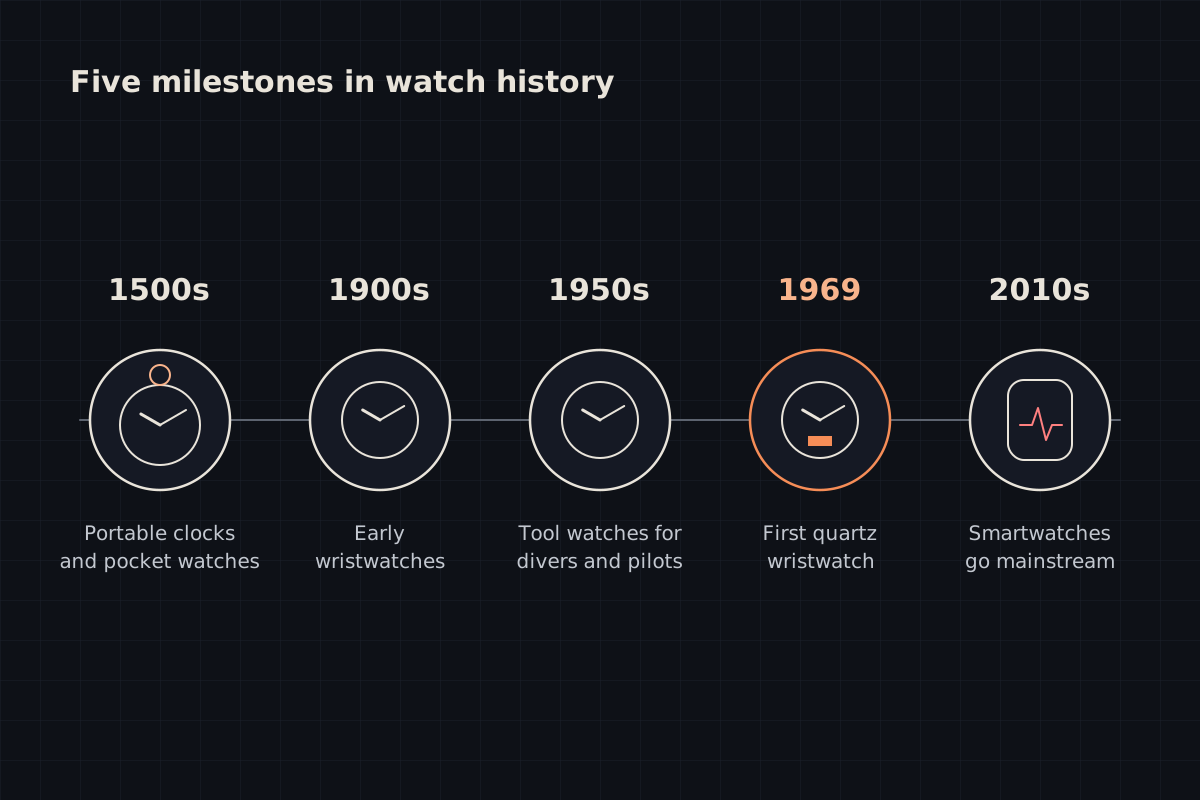
The history of watches begins in 16th-century Germany, where clockmakers first shrank spring-driven clocks small enough to carry. Over the next five hundred years, those heavy portable clocks became pocket watches, then wristwatches, then quartz and finally smartwatches. Along the way, wars, sport and one famous market crash changed how people tell the time. This guide walks you through each era in order, with the key dates checked against reliable sources.
- 1500s
Portable clocks
Spring-driven timekeepers small enough to carry appear in Europe, worn on chains or carried in pouches.
- 1700s
Pocket watches
Pocket watches become the everyday way to carry time, with steadily better escapements.
- 1900s
Early wristwatches
Wristwatches move from novelty to necessity, helped by soldiers and pilots who needed both hands free.
- 1926
The Rolex Oyster
A sealed case design brings practical water resistance to the wristwatch.
- 1950s
Tool watches
Diving, pilot and GMT watches set the templates many sports watches still follow.
- 1969
Quartz Astron
Seiko launches the first quartz wristwatch on 25 December, and the industry changes.
- 1970s–80s
The quartz crisis
Cheap, accurate quartz watches push many traditional Swiss makers out of business.
- 2015 →
Smartwatches
Connected watches go mainstream, while mechanical watches thrive as craft and heritage.
The early history of watches: portable clocks
Before watches, clocks ran on falling weights, so they had to stay put. The breakthrough was the mainspring, a coiled spring that stores energy and releases it slowly. Because of it, clockmakers could build timepieces that worked in any position. The first timepieces worn on the body came from Nuremberg and Augsburg. They date from the 16th century.
These early pieces sat somewhere between a clock and a watch. They were often worn on a chain around the neck or pinned to clothing. Most had only an hour hand, and they could drift by an hour or more a day. In fact, they were as much jewellery and status symbols as practical tools.
Who invented the watch? A disputed claim
You will often read that Peter Henlein, a Nuremberg locksmith who lived from 1485 to 1542, invented the watch. However, this claim rests mostly on a 1511 text by the scholar Johann Cochlaeus, who praised Henlein's small clocks. Other German makers were building similar pieces at the same time, and there is no firm evidence that Henlein came first. Similarly, a small pomander watch engraved "1505" is sometimes linked to him, but museum experts have questioned that link. So the honest answer is that nobody knows for sure who made the first watch.
The pocket watch era in the history of watches
Watches only became common in pockets during the 17th century. At the same time, accuracy took a big step forward. In 1657, the balance spring was added to the balance wheel, an invention that Robert Hooke and Christiaan Huygens both claimed. As a result, a good watch could now keep time to within minutes a day rather than hours.
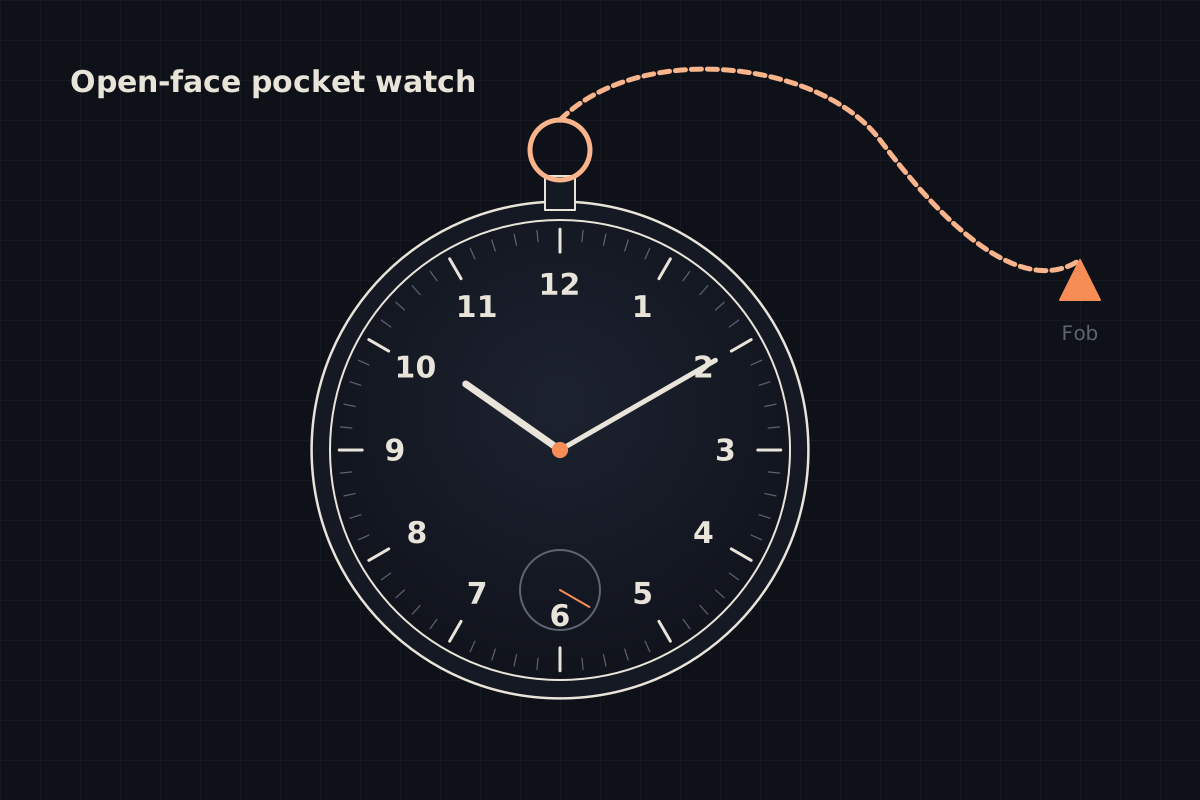
For the next three centuries, the pocket watch was the standard for men. It sat in a waistcoat pocket on a chain, and railway workers, doctors and officers relied on it. Meanwhile, Swiss, English and later American makers competed to make thinner, more accurate and more complicated movements. Many of the terms you see on watches today, such as jewels, escapements and complications, come from this period of the history of watches.
Early wristwatches in the history of watches
At first, wristwatches were seen as jewellery for women. For example, in 1868 Patek Philippe made what is often called the first Swiss wristwatch, a decorative piece for Countess Koscowicz of Hungary. Men, by contrast, stuck with pocket watches for decades.
Then practical needs began to change minds. In 1904, Louis Cartier made a wristwatch for his friend Alberto Santos-Dumont, a Brazilian aviator. With it, he could check the time while keeping both hands on the controls. That watch became the Santos, and it remains one of the best-known early men's wristwatches. Even so, the wristwatch was still a niche item for men in the years before 1914.
Trench watches and the First World War
Military use did more than anything else to make the wristwatch normal for men. British officers had already used wrist-worn watches in colonial campaigns from the 1880s onwards. However, the First World War made them essential. In the trenches, soldiers needed to read the time instantly, for instance to coordinate an attack. Fumbling for a pocket watch was not practical. So many early "trench watches" were simply small pocket watches with wire lugs soldered on for a strap. After the war, returning soldiers kept wearing them, and the pocket watch slowly faded.
The 1926 Rolex Oyster and the waterproof case
Early wristwatches had a weakness: dust and water could get in through the crown and case back. In 1926, Rolex introduced the Oyster. It was a sealed case with a screw-down case back and crown, which the brand describes as the first waterproof wristwatch case. To prove it, Rolex gave a watch to the swimmer Mercedes Gleitze, who wore it during a Channel swim attempt in 1927. The watch kept running after hours in cold water, and Rolex used the story in its advertising. In short, the Oyster showed that a wristwatch could be a tough, everyday tool.
The 1950s: the age of tool watches
After the Second World War, watchmakers built watches for specific jobs. This was the golden age of the tool watch in the history of watches. Many of these designs are still in production. Above all, two professions drove the change: divers and pilots.
The first dive watches
The modern dive watch took shape in 1953. That year, Blancpain delivered the first Fifty Fathoms, designed for French navy combat divers, with a rotating bezel to track time underwater. Rolex developed its Submariner in the same year and presented it at the Basel watch fair in 1954. Collectors still argue about which came first, so it is fair to say both brands shaped the category together.
The GMT-Master and jet travel
Meanwhile, long-distance air travel created a new problem: pilots crossed time zones faster than ever. In 1954, Rolex introduced the GMT-Master reference 6542, developed with Pan Am. It added a 24-hour hand and a rotating 24-hour bezel, so a pilot could read two time zones at once. Today, the GMT is one of the most popular complications in the history of watches.
1969: the year that changed the history of watches
In 1969, two very different revolutions happened at once. First, mechanical watchmakers finally solved the automatic chronograph, a self-winding chronograph watch. Zenith announced its El Primero in January 1969, while the Chronomatic group (Heuer, Breitling, Hamilton-Buren and Dubois Dépraz) launched its Calibre 11. At the same time, Seiko released its 6139 in Japan. Each can claim to be first in a different sense, depending on whether you count the announcement or the sale date.
Second, and far more important, Seiko launched the Quartz Astron 35SQ in Tokyo on 25 December 1969. It was the first quartz wristwatch on sale. According to Seiko's own account, it cost 450,000 yen, about the price of a medium-sized car. It also kept time to about five seconds a month. The idea itself was older, though. Warren Marrison and J. W. Horton had built the first quartz clock at Bell Telephone Laboratories in 1927.
The quartz crisis of the 1970s and 1980s
Switzerland had its own quartz research. In fact, the Beta 21, the first Swiss analogue quartz movement, appeared at the 1970 Basel Fair. A consortium called the Centre Electronique Horloger made it. In addition, Hamilton launched the Pulsar, the first electronic digital watch, in the early 1970s. Yet Swiss industry stayed largely committed to mechanical watches, a choice that would reshape the history of watches.
That proved costly. As quartz prices fell, cheap and accurate watches from Japan and elsewhere flooded the market. According to Wikipedia's account of the quartz crisis, Swiss watch employment fell from about 90,000 in 1970 to about 28,000 in 1988. Over a similar period, the number of Swiss watch firms dropped from about 1,600 to about 600. Today, people call this collapse the quartz crisis, and it is the sharpest turn in the history of watches. To understand the technology behind it, our guide to the quartz watch explains how a quartz crystal keeps time.
Swatch and the mechanical revival
The Swiss fightback came from an unlikely product. In March 1983, Swatch launched a cheap plastic quartz watch with few parts, designed to be built by machine. It was sold as a fun, colourful accessory rather than a serious instrument. It sold in huge numbers, and the companies behind it later became the Swatch Group.
At the same time, Swiss brands rethought the mechanical watch. Since quartz now did the job of telling time cheaply, a mechanical watch became something else: a crafted, luxury object. As a result, from the late 1980s onwards, brands promoted heritage, hand finishing and complications. This shift explains why the debate over quartz vs automatic watch is today about taste, not just accuracy.
Smartwatches and the modern history of watches
The latest chapter in the history of watches is connected technology. Apple unveiled the Apple Watch on 9 September 2014, and it went on sale in nine countries on 24 April 2015. It made the smart watch a mainstream product, with fitness tracking, notifications and payments on the wrist. Once again, traditional watchmakers faced a new kind of rival, much as they had in the 1970s.
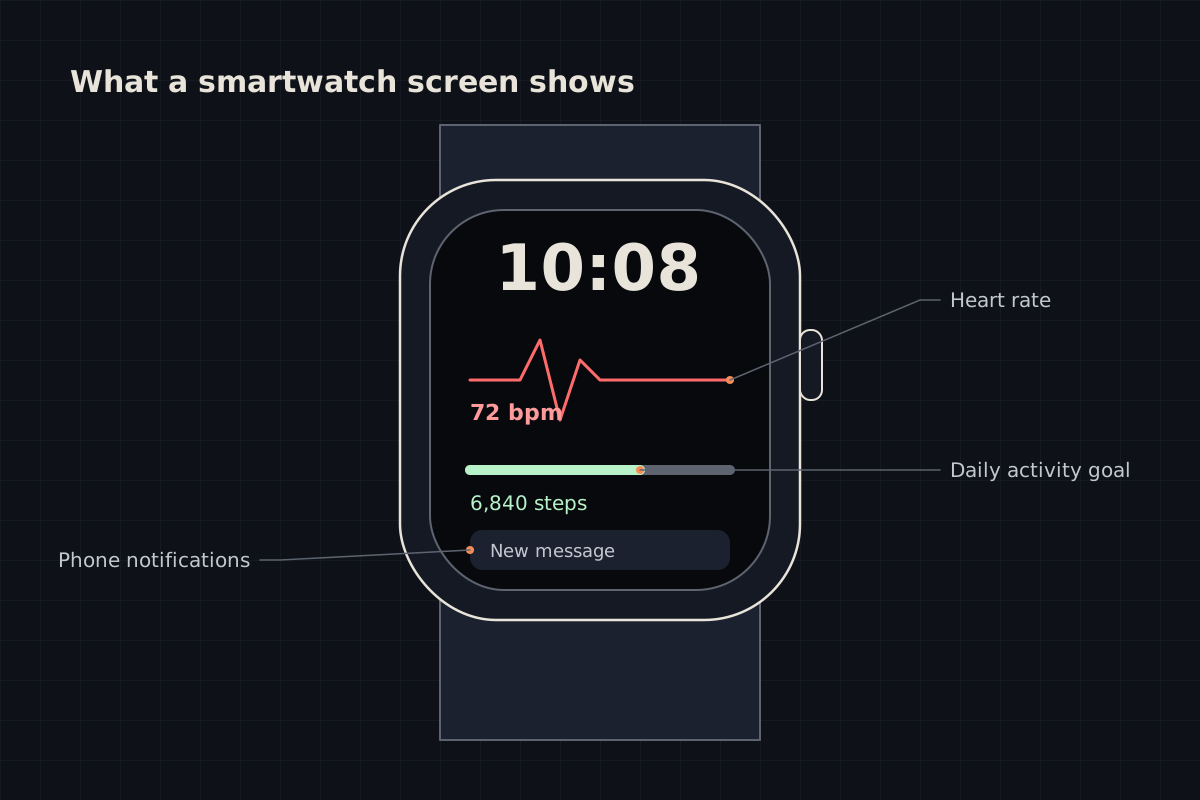
So far, mechanical watches have survived this challenge too. Many buyers now own both: a smartwatch for sport and daily tasks, and a mechanical watch for its craft and history. In other words, across the history of watches, the watch has moved from pure tool to tool, jewellery and statement.
Why the history of watches matters when you buy
Knowing the history of watches helps you read a watch more clearly. For example, a rotating bezel, a 24-hour hand or a screw-down crown each began as a solution to a real problem. Similarly, terms such as "chronometer" or "Swiss Made" carry meaning shaped by centuries of competition. When you shop, ask which era a design comes from and what job it was built to do. That way, you will understand why two watches that look alike can cost very different amounts.
Frequently asked questions
Who invented the watch?
No single person can be named with certainty. Peter Henlein of Nuremberg (1485–1542) is often credited, mainly because a 1511 text praised his small portable clocks. However, other German makers built similar pieces at the same time, and historians say there is no firm evidence that Henlein was first.
What was the first wristwatch?
Patek Philippe made what is often called the first Swiss wristwatch in 1868 for Countess Koscowicz of Hungary. It was a jewellery piece worn on a bracelet. For men, Cartier's 1904 watch for aviator Alberto Santos-Dumont is one of the best-known early examples, and soldiers made wristwatches common during the First World War.
What was the quartz crisis?
The quartz crisis was the collapse of much of the Swiss mechanical watch industry in the 1970s and early 1980s. Cheap, accurate quartz watches, many from Japan, took over the market. Swiss watch employment fell from about 90,000 in 1970 to about 28,000 by 1988, before Swatch and luxury mechanical watches helped the recovery.
When was the first quartz watch made?
The first quartz wristwatch on sale was the Seiko Quartz Astron 35SQ, released in Tokyo on 25 December 1969. It cost 450,000 yen, around the price of a medium-sized car at the time. The underlying technology was older: Bell Telephone Laboratories built the first quartz clock in 1927.
When did the Apple Watch come out?
Apple unveiled the Apple Watch on 9 September 2014, and it went on sale in nine countries on 24 April 2015. Its arrival made the smartwatch a mainstream product and raised new questions for traditional watchmakers, much as quartz had done in the 1970s.
Sources
- Wikipedia: Watch (history section)
- Wikipedia: Peter Henlein
- Rolex: Mastering waterproofness
- WatchTime: Reaching new depths, a history of the dive watch
- Bob's Watches: The first Rolex GMT-Master reference 6542
- Seiko: The story of the Quartz Astron
- Gear Patrol: 1969 was a watershed year in watches
- Wikipedia: Quartz crisis
- Wikipedia: Warren Marrison (first quartz clock, 1927)
- Apple Newsroom: Apple Watch available in nine countries on April 24
Prices, specifications and availability change. Check the brand's official Malaysian site or an authorised retailer before you buy.