
Watch Battery Replacement: Signs, Cells, Tools and Safety
Changing a quartz watch battery looks simple, but the seal, the cell type and the case back all decide whether it ends well.
Key takeaways
- On many Seiko and Citizen models, a seconds hand that jumps every two seconds is a low-power warning; check your manual, as it varies by brand.
- Most analogue quartz watches use small silver-oxide cells such as SR626SW (also sold as 377).
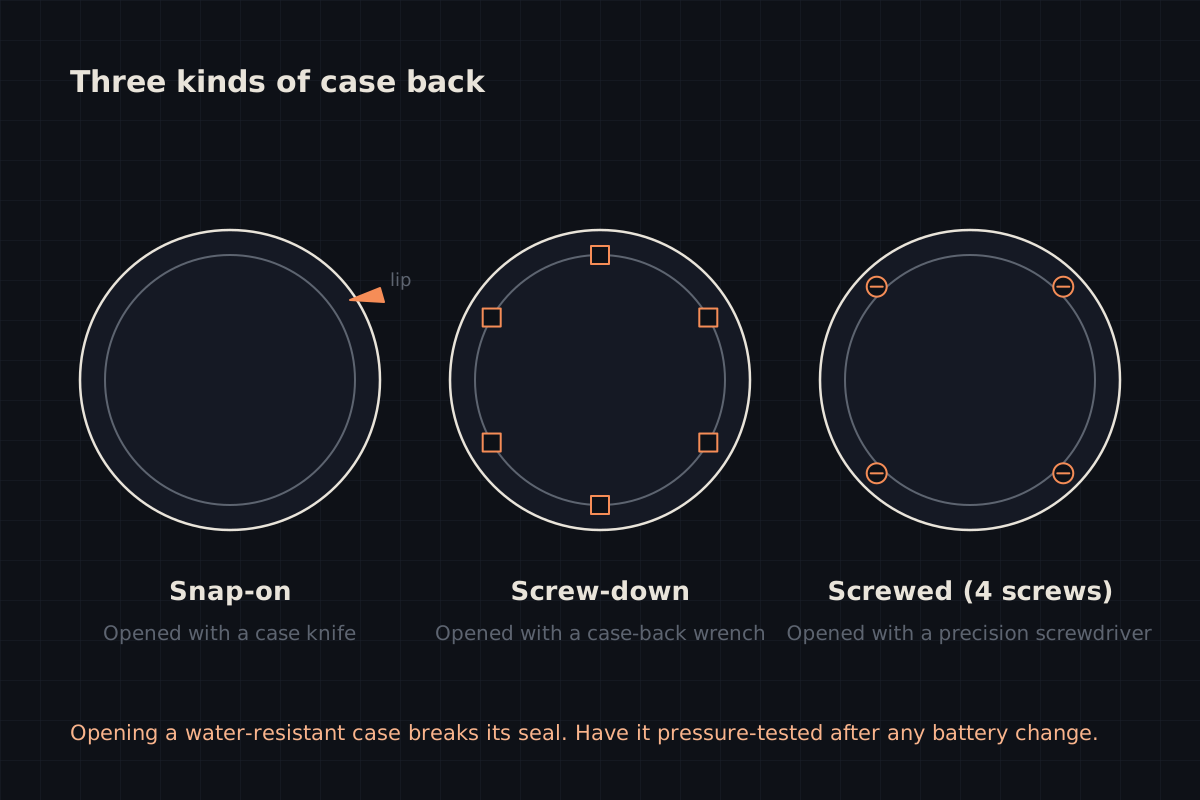
- Case backs come in three main types: snap-on, screw-down and screwed with small screws, each needing its own tool.
- Opening a watch can weaken its water resistance, so a pressure test afterwards matters for any watch you swim with.
- Solar and Kinetic watches use a rechargeable cell; never fit an ordinary battery in its place.
A watch battery replacement is one of the simplest jobs in watch care, yet it is also where many watches pick up scratches or lose their seal. A typical quartz watch runs on a small coin cell for a few years. When that cell fades, you can take the watch to a service centre or, with care, do it yourself. This guide explains the warning signs, the common cell types and the tools. It also sets out the risks honestly, so you can decide which route suits your watch.
Signs your watch needs a battery replacement
The clearest sign is a change in how the seconds hand moves. On many Seiko quartz models, the small seconds hand starts jumping every two seconds when the battery is close to empty. Seiko's instructions describe this as the battery life indicator. Citizen uses a similar two-second jump on Eco-Drive models when their charge runs low. However, this varies by brand, and some movements use a different pattern or none at all.
Other signs are simpler. For example, the watch may lose time, stop overnight or show a faint display if it is digital. Also, a brand-new watch can need a cell sooner than you expect. That is because the factory fits a "monitor" battery to test the movement, as both Seiko and Citizen point out. So check your manual first, because it tells you exactly which warning your model uses.
Common watch battery types
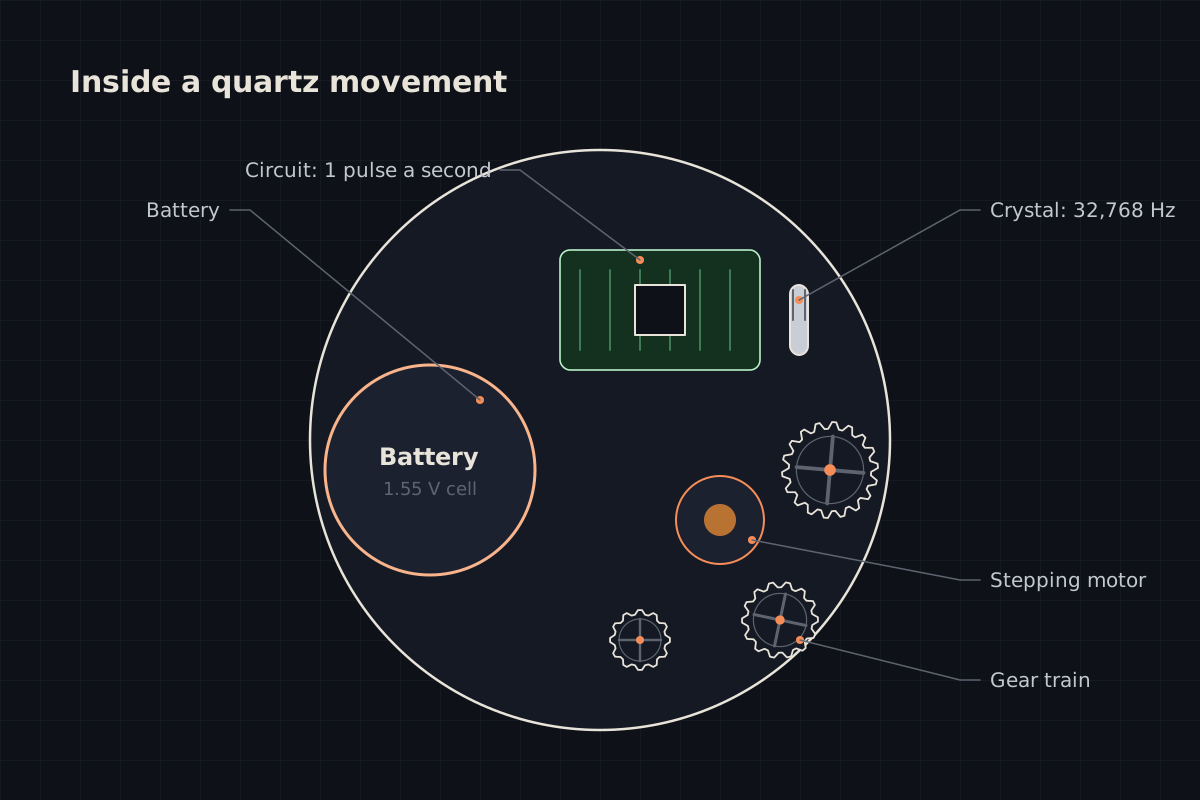
Most analogue quartz watches use silver-oxide button cells. These give a steady 1.55 volts for most of their life. Digital and some multi-function watches often use 3-volt lithium coin cells instead. The code on the old cell, or in your manual, tells you which one to buy. Always match it exactly, because a cell that is slightly thicker can press on the movement. In fact, the right cell is the first step in any watch battery replacement.
| IEC code | Common number | Type | Size (diameter × height) |
|---|---|---|---|
| SR626SW | 377 | Silver oxide, 1.55 V | 6.8 × 2.6 mm |
| SR621SW | 364 | Silver oxide, 1.55 V | 6.8 × 2.1 mm |
| SR920SW | 371 | Silver oxide, 1.55 V | 9.5 × 2.0 mm |
| SR927SW | 395 | Silver oxide, 1.55 V | 9.5 × 2.7 mm |
| CR2016 | 2016 | Lithium, 3 V | 20 × 1.6 mm |
The Energizer 377 datasheet confirms that cell as a 1.55 V silver-oxide type that replaces SR626SW. Similarly, maker cross-reference charts, such as Murata's, link each IEC code to its common number. In short, the code is what matters, not the brand on the packet.
Case back types and tools for a watch battery replacement
Before you start, look closely at the back of the case. There are three main designs, and each needs its own tool. Using the wrong one is the fastest way to scratch a case or crack a seal.
Snap-on case backs
A snap-on back presses into place and has a small notch at the edge. To open it, you slip a case knife into that notch and twist gently. It needs a press with the right die to close it again, because pressing by hand can crack the crystal.
Screw-down case backs
A screw-down back has several notches or flats around its rim. In this case, you need an adjustable case wrench, or a rubber ball tool for light grips. Turn it anticlockwise to open. These backs are common on sports and dive models, so the seal matters even more.
Case backs with small screws
Some backs are held by four or more tiny screws. So you need a precision screwdriver that fits the slot exactly. Loosen the screws a little at a time, in a criss-cross order, and keep them in a tray.
DIY watch battery replacement, step by step
If you choose to do it yourself, work slowly on a clean, soft mat. Here are the basic steps.
- First, confirm the cell code from your manual or the brand's website.
- Next, open the case back with the correct tool, without forcing it.
- Note how the old cell sits, and whether a small clip or strap holds it in.
- Then lift it out with plastic tweezers, because metal ones can short the cell.
- After that, fit the new cell the same way up, touching only its edges.
- Check the rubber gasket for cracks or flattening, and seat it evenly in its groove.
- Finally, close the back and confirm the seconds hand ticks normally.
The risks of a DIY watch battery replacement
The biggest risk is the seal. The gasket under the case back keeps out dust and moisture, and it is easy to pinch or stretch. Also, any dust that gets in can stop the movement later, as Citizen warns. Then there is the case itself: one slip of a knife can scratch a polished back for good. Finally, static or metal tools can damage the circuit.
When to use a service centre for watch battery replacement
For expensive, water-resistant or sentimental watches, a professional watch battery replacement is the safer route. Seiko, for example, asks owners to have the battery changed at the retailer, using a genuine Seiko cell. An official service centre also has the right press, the right gaskets and a pressure tester. You can find official contacts on our service centres page. In addition, brand service keeps your service history clear, which helps if you ever sell the watch.
Why a pressure test matters after opening
A water-resistance rating relies on every seal working together. Once the back comes off, that seal is no longer proven. So a pressure test after a watch battery replacement checks that the case still keeps out water. Seiko recommends a water resistance check after battery changes on models rated 10 bar or more. If you swim or dive with your watch, treat this step as essential. Our guide to water resistance explains what the ratings really mean.
Solar, Eco-Drive and Kinetic watches are different
Not every quartz watch uses a disposable cell. Solar models, such as Citizen Eco-Drive, and Seiko Kinetic models store energy in a rechargeable secondary cell. That cell is built to last many years, so no routine watch battery replacement is needed. Instead, you recharge it with light or, for Kinetic, with wrist movement. Seiko adds a clear warning: never fit an ordinary silver-oxide battery in its place, because it can heat up and even burst. If a rechargeable cell stops holding a charge, let a service centre replace it.
Mechanical watches, of course, need no battery at all. If you are weighing the two systems, our quartz vs automatic watch guide compares running costs and servicing.
Safe disposal and keeping coin cells from children
Button and coin cells look harmless, but they are dangerous if swallowed. The Royal Children's Hospital Melbourne warns that a swallowed button battery can burn a child's food pipe within about two hours. Even a "flat" cell can still hold enough charge to cause harm. So keep new and old cells locked away, out of sight and out of reach.
- Cover both sides of a used cell with tape so it cannot short out.
- Take it to a battery recycling or e-waste collection point, rather than the household bin.
- Store spare cells in their original sealed packs, high up and out of reach.
- If you think a child has swallowed a cell, call 999 or go to the nearest emergency department at once.
Watch battery replacement in short
In summary, a watch battery replacement starts with spotting the signs and confirming the exact cell code. Then choose your route. A DIY job suits a simple, low-value watch with a snap-on or screw-down back. However, for anything water resistant, valuable or solar-powered, an official service centre is the better choice. Either way, dispose of the old cell safely and keep spares away from children.
Frequently asked questions
How do I know my watch battery is running low?
On many Seiko and Citizen quartz models, the seconds hand starts jumping in two-second steps instead of ticking every second. Other watches simply lose time or stop. Digital models may show a dim display or a battery warning. Because signals vary by brand, check your manual to see which indicator your watch uses.
How to change watch battery at home?
Identify the case back type, open it with the correct tool, note how the old cell sits, lift it out with plastic tweezers and fit an identical new one. Check the gasket, then close the back evenly. Remember that this can weaken water resistance and may affect your warranty.
How to open watch back safely?
First, find out the type. A snap-on back has a small notch and needs a case knife. A screw-down back has notches around the edge and needs an adjustable case wrench. A back with small screws needs a precision screwdriver. Work on a soft mat, and stop if anything resists.
Does a watch need a pressure test after a battery change?
If you rely on its water resistance, yes. Opening the case disturbs the gasket, and a tiny gap can let in moisture. Seiko recommends a water resistance check after battery changes on models rated 10 bar or more. A service centre can test the seal with the right equipment.
Do Eco-Drive and Kinetic watches need new batteries?
Not in the usual way. They store energy in a rechargeable cell that is designed to last many years. If one stops holding a charge, a service centre should replace the cell. Seiko warns that fitting an ordinary silver-oxide battery in its place can cause heat and even bursting.
Sources
- Seiko: Remarks on battery (calibre 8T61/8T63/8T67 instructions)
- Seiko: When the second hand jumps in 2-second intervals or stops (solar FAQ)
- Seiko: Power source, secondary battery (instructions)
- Citizen: Battery replacement and maintenance
- Citizen: The second hand on my Eco-Drive watch jumps instead of ticking every second
- Energizer: 377/376 silver oxide datasheet
- Murata: Watch battery cross reference
- The Royal Children's Hospital Melbourne: Button battery safety
Prices, specifications and availability change. Check the brand's official Malaysian site or an authorised retailer before you buy.