
Diving Watch Guide: Water Resistance, ISO 6425 and Care
How a dive watch keeps time and water out, what the depth on the dial really means, and how to keep the seals healthy.
Key takeaways
- A true diving watch has a unidirectional bezel, strong lume and a screw-down crown.
- ISO 6425 requires at least 100 m and tests each watch at 125% of its rated pressure.
- The metre rating comes from a static lab test, so it is not a safe diving depth.
- Use 100 m for swimming and snorkelling, and 200 m or more for scuba diving.
- Rinse after salt water or chlorine and have the gaskets checked about every two years.
A diving watch is a tool built to time a dive and survive the pressure, salt and knocks that come with it. Unlike a fashion piece, it follows a clear set of rules. However, many people buy one simply because they like the look. That is fine, because the same toughness makes a diving watch a great daily partner in Malaysia's heat, rain and humidity.
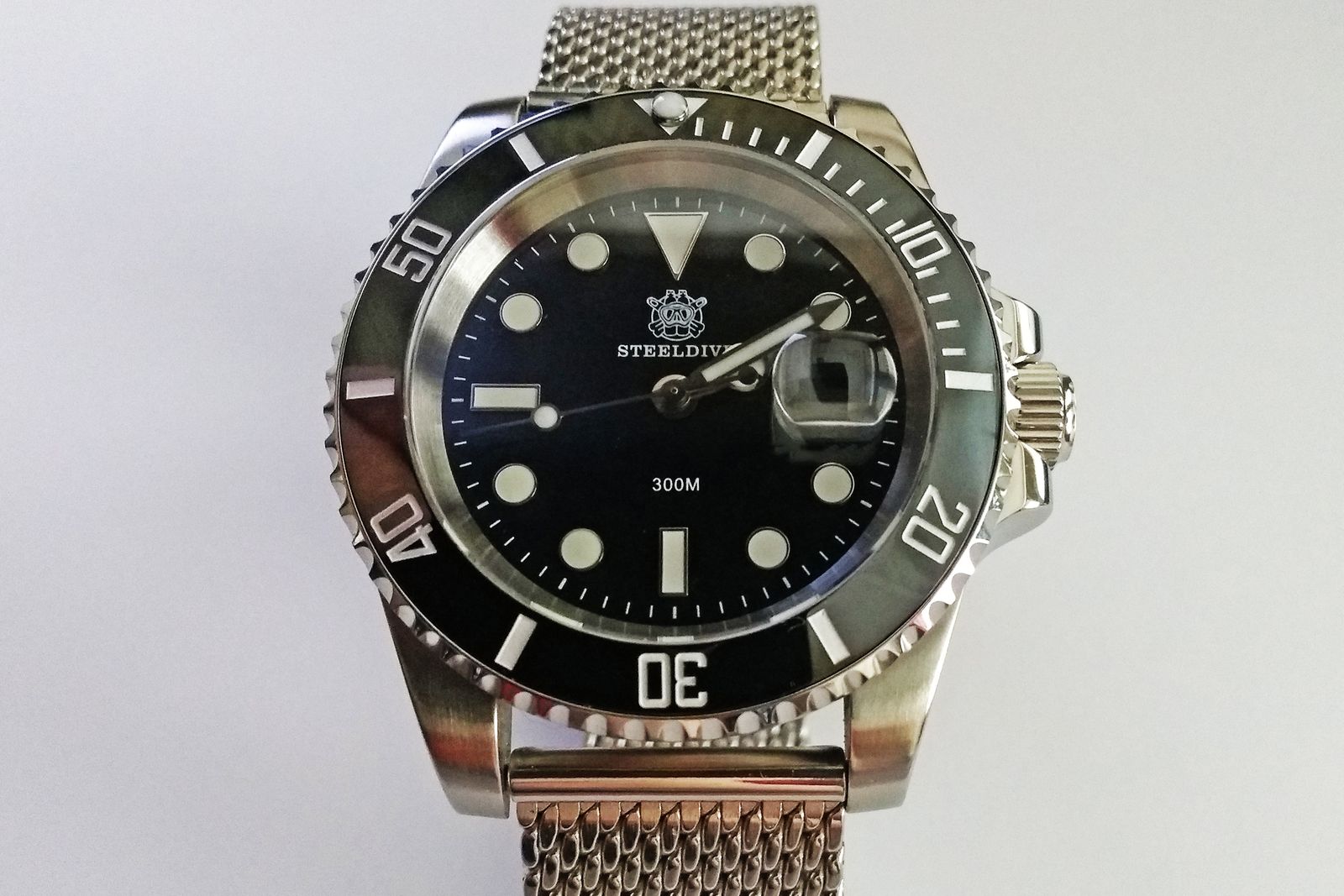
What makes a diving watch
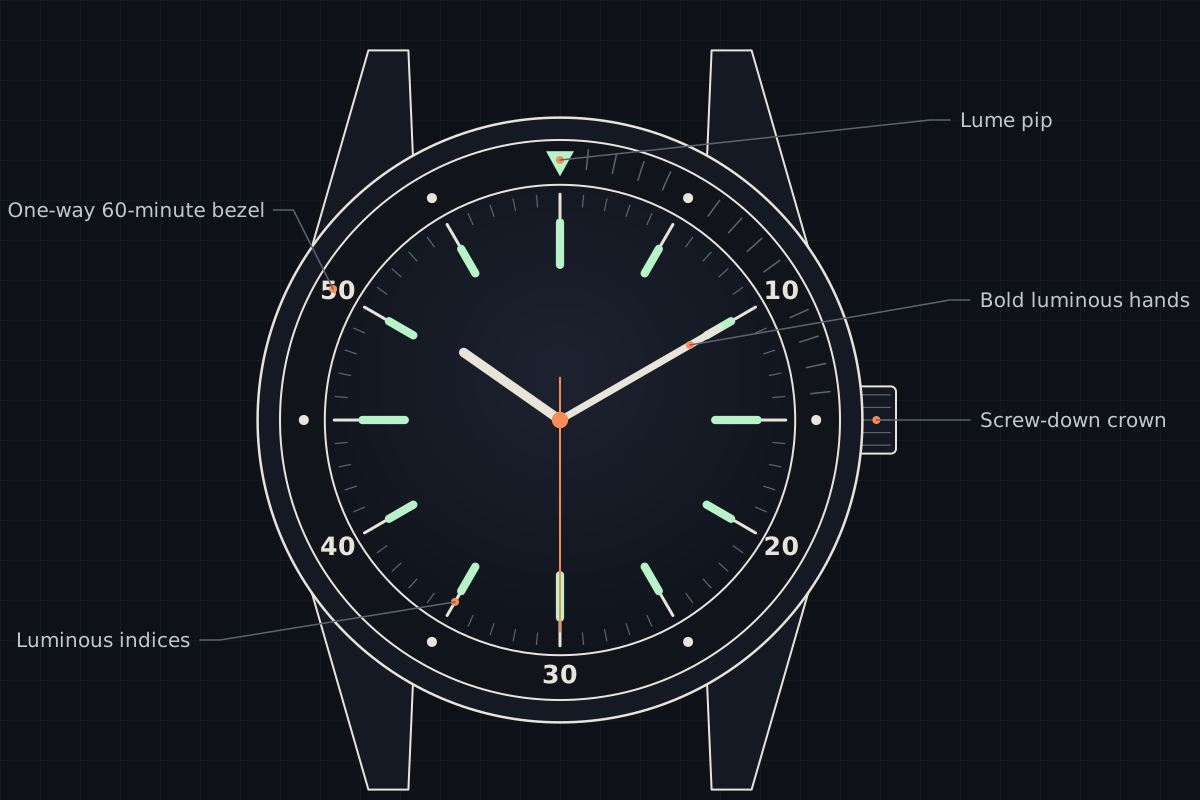
First, look at the bezel. A true diving watch has a unidirectional bezel marked from 0 to 60 minutes. Before you descend, you line up the zero marker, often a glowing pip, with the minute hand. As a result, you can read your elapsed time at a glance. The bezel turns only anticlockwise, so a knock can only make your dive look longer, never shorter.
Next comes legibility. Deep water is dark, so the hands and markers carry thick luminous paint. In addition, the minute hand is usually larger, so you can tell it apart from the hour hand. Most models also have a screw-down crown, which squeezes a gasket to keep water out. Finally, the case back usually screws down too, and the crystal is thick sapphire or mineral glass.
- Unidirectional bezel: times the dive and fails safe if you bump it.
- Lume: bright paint on the hands, markers and bezel pip.
- Screw-down crown: seals the winding stem against water.
- Running indicator: a glowing seconds hand that shows the watch is working.
ISO 6425: the diving watch standard
The international rulebook for this category is ISO 6425, last revised in 2018. In short, it sets the minimum a diving watch must meet before it can carry the word "diver's" on its dial. For example, the watch needs a rating of at least 100 m. It also needs a time-preselection device, such as a one-way bezel, that resists accidental turning.
Testing goes much further than for an ordinary watch. Each piece faces water pressure at 125% of its rating, so a 200 m watch must survive the equivalent of 250 m. Then the lab checks the crown under pressure, as well as resistance to shock, magnetism and salt water. In addition, the time, bezel and running indicator must stay readable at 25 cm in total darkness.
Water resistance ratings explained
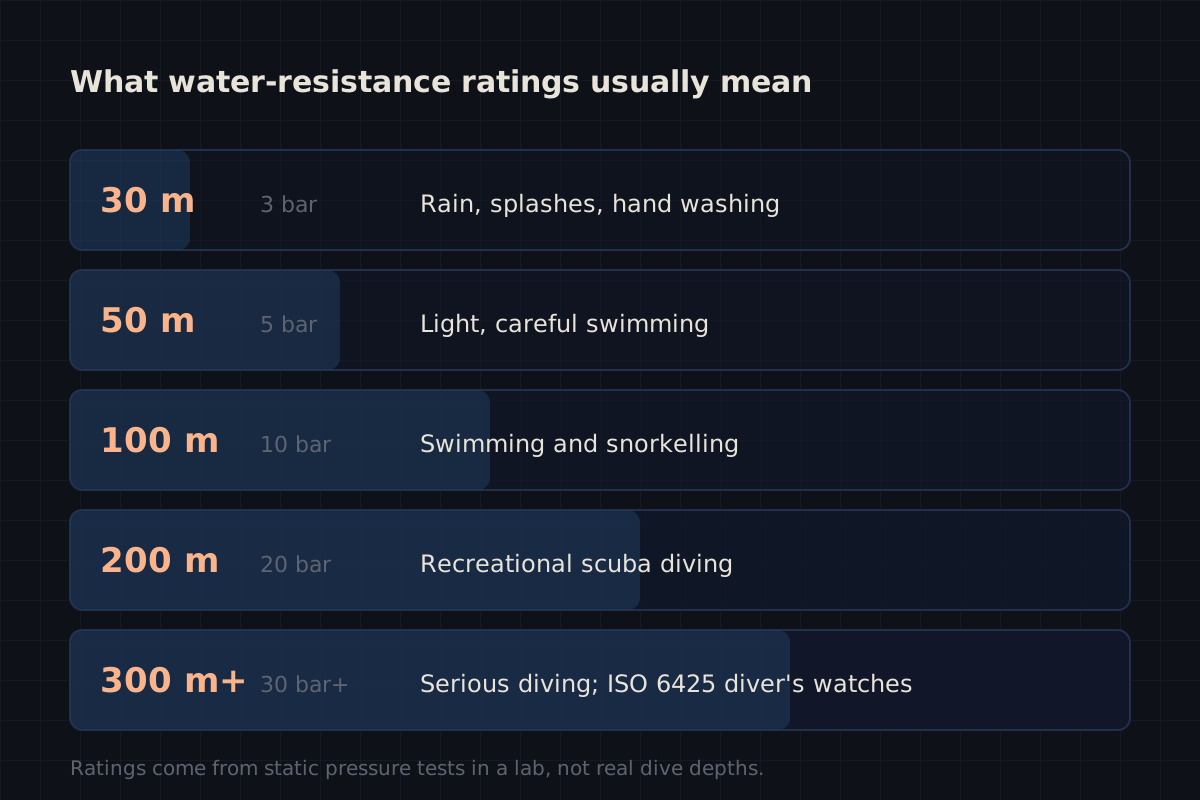
Every watch, not only a diving watch, carries a water-resistance figure. Brands state it in metres, ATM or bar. As a rule, 1 ATM is roughly 1 bar, and both equal about 10 m of water. So a 100 m watch is the same as 10 bar or 10 ATM. However, the number on the dial is not a promise about real-world depth, as the next section explains.
| Rating | ATM / bar | OK for | Not for |
|---|---|---|---|
| 30 m | 3 | Rain, splashes, hand-washing | Swimming, showers |
| 50 m | 5 | Light, careful swimming | Snorkelling, diving |
| 100 m | 10 | Swimming and snorkelling | Scuba diving |
| 200 m+ | 20+ | Recreational scuba diving | Saturation diving, unless rated for it |
Why the metre rating is not a safe depth
The rating comes from a static lab test. In other words, the watch sits still in a chamber while the pressure slowly rises. Real life is different. When you jump into a pool or swing your arm through a wave, you create brief spikes in pressure. Heat from hot showers and saunas also ages the rubber gaskets. As a result, a 30 m watch can leak in a pool that is only 2 m deep.
ISO 22810 and everyday watches
Ordinary water-resistant watches follow a separate standard, ISO 22810, which replaced the older ISO 2281 in 2010. It covers any watch sold as water-resistant, whatever the brand. Meanwhile, ISO 6425 adds the extra diving tests on top. So a 100 m dress watch and a 100 m diving watch are not equal, because only a certified diver has passed the tougher checks.
Also, some elegant watches offer very little protection. For instance, many dress models, including some Cartier Tank and Patek Philippe Calatrava references, carry only a 30 m rating. That is enough for rain and washing your hands, but you should take them off before a swim. If you want one watch for everything, a sporty pick from our guide to watches for men is a safer bet.
A short history of the diving watch
Sealed watches existed long before the 1950s. However, the modern diving watch took shape in 1953. That year Blancpain launched the Fifty Fathoms, the idea of its chief executive Jean-Jacques Fiechter, who was a keen diver. It had a locking rotating bezel, large luminous hands and a double-sealed crown. Two French combat-diving officers, Robert Maloubier and Claude Riffaud, wanted the same features, and French combat divers soon wore it.
Rolex followed closely. Its Submariner went into production in 1953 and appeared at the Basel fair in 1954, with a rating of 100 m. Since then, the basic recipe has barely changed. You can follow the wider story in our history of watches. Meanwhile, Blancpain's own magazine, Lettres du Brassus, tells the Fifty Fathoms story in rich detail.
Helium escape valves: who needs one
Some professional models have a small valve on the side of the case. This is a helium escape valve. Saturation divers live for days in pressurised chambers filled with a helium mix. Helium atoms are tiny, so they slowly creep into the watch. Then, during decompression, the trapped gas can push the crystal off. The valve lets that gas out safely. For leisure diving, however, you do not need one at all.
Caring for your diving watch after the sea or pool
Salt and chlorine are hard on seals and metal. So, after every swim, rinse your diving watch under cool fresh water. Then dry it with a soft cloth. Also, turn the bezel a few times while you rinse, because salt can collect underneath and make it stiff. In addition, avoid hot tubs and saunas, since heat ages rubber gaskets faster than cold water does.
- Check that the crown is fully screwed down before you enter the water.
- Never pull the crown or press any pushers underwater.
- Rinse rubber and fabric straps too, and let them dry fully.
Your strap matters as well. Leather hates water, while rubber and fabric shrug it off. Our watch strap guide explains which materials suit a beach holiday or a humid commute. Likewise, a steel bracelet copes well with water, although you should still rinse sand out of the links.
Gasket checks and pressure tests
Water resistance does not last forever. Rubber gaskets slowly harden from heat, sunlight, soap and salt. Because of this, the Swiss dive-watch brand Aquastar suggests a gasket check and pressure test roughly every couple of years. In addition, ask for fresh seals at every full service. Similarly, ask for a pressure test after any battery change on a quartz diver.
Look out for warning signs, too. If you see mist under the crystal after a swim, stop using the watch in water and have it checked soon. Moisture quickly leads to rust on the movement, so a fast response can save you a costly repair later.
How to choose a diving watch
Start with how you will use it. For pool laps and snorkelling, 100 m with a screw-down crown is plenty. For scuba, look for 200 m and a "diver's" marking under ISO 6425. Then think about comfort, because dive cases tend to be thick and wide. Finally, consider the movement. An automatic watch needs no battery, while a quartz watch keeps better time and costs less.
Diving pieces also belong to a wider family of tool watches. For example, a chronograph watch times laps and races, while a GMT watch tracks a second time zone for travellers. Some models even combine a dive bezel with a GMT hand. Overall, a good diving watch is the most versatile of the three, because it shrugs off water, sweat and knocks with ease.
Above all, match the rating to your real habits rather than to a dream trip. A diving watch rated to 200 m will never mind a swimming pool. On the other hand, a delicate 30 m dress watch will not forgive a single careless dip. Check the ISO water-resistance rules if a listing seems vague, and ask the seller for the exact rating.
Frequently asked questions
What is a diving watch?
A diving watch is a water-resistant watch built to time a dive. It has a one-way rotating bezel, bright luminous hands and markers, and usually a screw-down crown. Watches certified to ISO 6425 must be rated to at least 100 m and pass extra tests for pressure, shock, magnetism and salt water.
What does ISO 6425 mean on a watch?
ISO 6425 is the international standard for divers' watches. A watch that meets it has passed tests at 125% of its rated pressure, plus checks for legibility in the dark, shock, magnetism and salt water. Only these watches should carry the word "diver's" with a depth rating on the dial.
Can I swim with a 50 m water-resistant watch?
You can usually take a 50 m watch for light, careful swimming, but it is not ideal. Diving in, splashing hard or hot showers can push water past the seals. For regular swimming or snorkelling, choose a watch rated to 100 m with a screw-down crown, and keep the crown closed in water.
What does 10 ATM water resistance mean?
10 ATM means the watch passed a static pressure test equal to about 100 m of water, because 1 ATM is roughly 1 bar or 10 m. In practice a 10 ATM watch suits swimming and snorkelling. It is not meant for scuba diving, where 200 m or more is the usual choice.
How often should I pressure test my diving watch?
Have the gaskets checked and the case pressure tested roughly every two years, or sooner if you swim in the sea or pool often. Also ask for new seals at every full service and after any battery change. If you see mist under the crystal, stop wearing it in water and get it checked.
Sources
- Wikipedia: Water Resistant mark (ISO 22810 and ISO 6425)
- SNV (Swiss Association for Standardization): ISO 6425:2018 Divers' watches
- Blancpain Lettres du Brassus: Fifty Fathoms, history and legend
- Blancpain Lettres du Brassus: Fifty Fathoms evolution
- Bob's Watches: History of the Rolex Submariner
- Timex: Water-resistant vs waterproof watches
- Aquastar: What does a water-resistance rating mean?
- Aquastar: What is ISO 6425?
Prices, specifications and availability change. Check the brand's official Malaysian site or an authorised retailer before you buy.