
Chronograph Watch: How It Works, How to Use It and Icons
A plain-English guide to the stopwatch on your wrist, from the first press of a pusher to the Moonwatch.
Key takeaways
- A chronograph watch is a watch with a built-in stopwatch; a chronometer is a certified accurate watch.
- The top pusher starts and stops timing, and the bottom pusher resets the hands to zero.
- A tachymeter turns elapsed time into speed: 1 km in 30 seconds reads 120 km/h.
- Flyback and split-seconds models add faster resets or a second timing hand.
- Icons include the OMEGA Speedmaster, TAG Heuer Carrera and Monaco, Zenith El Primero and Rolex Daytona.
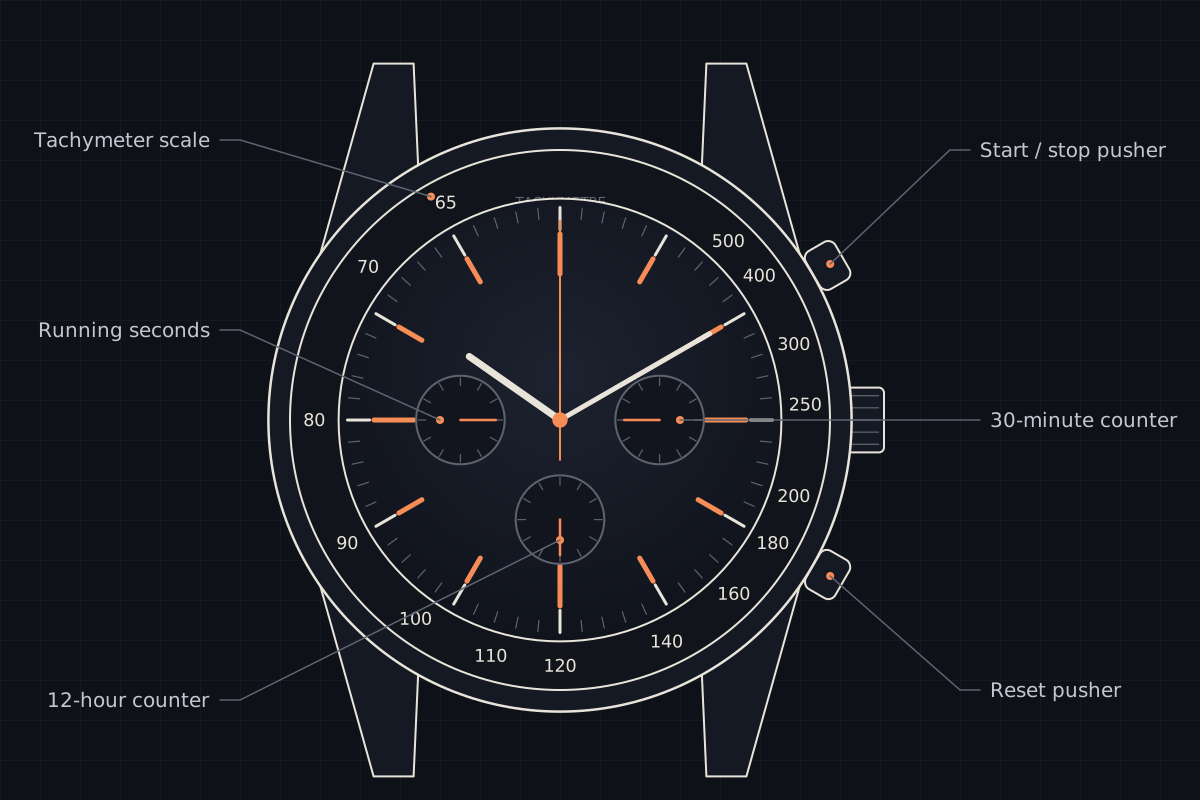
A chronograph watch is a watch with a stopwatch built into its movement. You can time a lap, a meeting or a boiled egg, while the main hands keep telling the time. Because of this, the chronograph is one of the most popular complications in watchmaking. It also looks the part, thanks to its busy dial and sporty pushers.
What is a chronograph watch?
The word comes from Greek: chronos means time and graph means writing. In practice, a chronograph watch adds a separate timing train that you switch on and off. The French inventor Louis Moinet built the first chronograph in 1816 for astronomy. Since then, it has served racing drivers, pilots, doctors and even astronauts.
Chronograph vs chronometer
People often mix up these two words. However, they mean very different things. A chronograph describes a function, namely the stopwatch. A chronometer, on the other hand, describes accuracy. It is a watch whose movement has passed an official test, such as the COSC trials in Switzerland. So a watch can be a chronograph, a chronometer, both or neither. Our watch glossary explains other terms like these.
How to use a chronograph watch
Most models have two pushers beside the crown. The usual layout is simple, although a few designs differ, so check your manual first.
- Press the top pusher at 2 o'clock to start timing. The large centre seconds hand begins to sweep.
- Press the top pusher again to stop. You can then read the elapsed time.
- Press it once more to restart and add more time, if you wish.
- Finally, press the bottom pusher at 4 o'clock to reset every timing hand to zero.
Never press the reset pusher while the chronograph is running, unless the watch is a flyback. Otherwise you may strain the parts inside. Also, avoid using the pushers underwater, even on a sporty model.
Reading the sub-dials
The small dials on the face are called sub-dials, or registers. Usually, one counts the elapsed minutes, often up to 30, and another counts the elapsed hours, often up to 12. Meanwhile, a third sub-dial shows the running seconds of the normal time. That small hand always moves, while the big centre hand moves only when the stopwatch runs. As a result, a glance at the centre hand tells you if the chronograph is on.
How to use the tachymeter on a chronograph watch
Many sporty models print a tachymeter scale on the bezel or the dial edge. It converts elapsed time into a speed. To use it, start the stopwatch as you pass a marker, such as a kilometre post. Then stop it at the next marker, one kilometre on. The centre hand now points to your average speed in units per hour.
For example, say you cover 1 km in 30 seconds. The hand points to 120 on the scale, so your speed is 120 km/h. The maths behind it is 3,600 divided by the seconds taken. Similarly, 45 seconds gives 80 km/h. Note that most scales work only for events lasting under a minute, because the printed numbers stop at 60.
Flyback and split-seconds chronographs
A flyback chronograph lets you reset and restart in one press while the timer runs. In contrast, a normal chronograph needs three presses: stop, reset and start. This suits anyone who times one interval after another, such as a pilot timing each leg of a flight.
A split-seconds chronograph, or rattrapante, goes further still. It has two centre seconds hands stacked on top of each other. When you press an extra pusher, one hand stops while the other keeps running. So you can time two events that start together, such as two runners in a race. Because it is so complex, the rattrapante usually sits at the top end of the market.
Column wheel vs cam: inside the chronograph watch
Inside a mechanical chronograph, a control part tells the levers when to start, stop and reset. The traditional choice is the column wheel, a small castellated wheel that turns one step with each press. Fans love it because the pushers feel smooth and crisp. However, it takes more skill and cost to make.
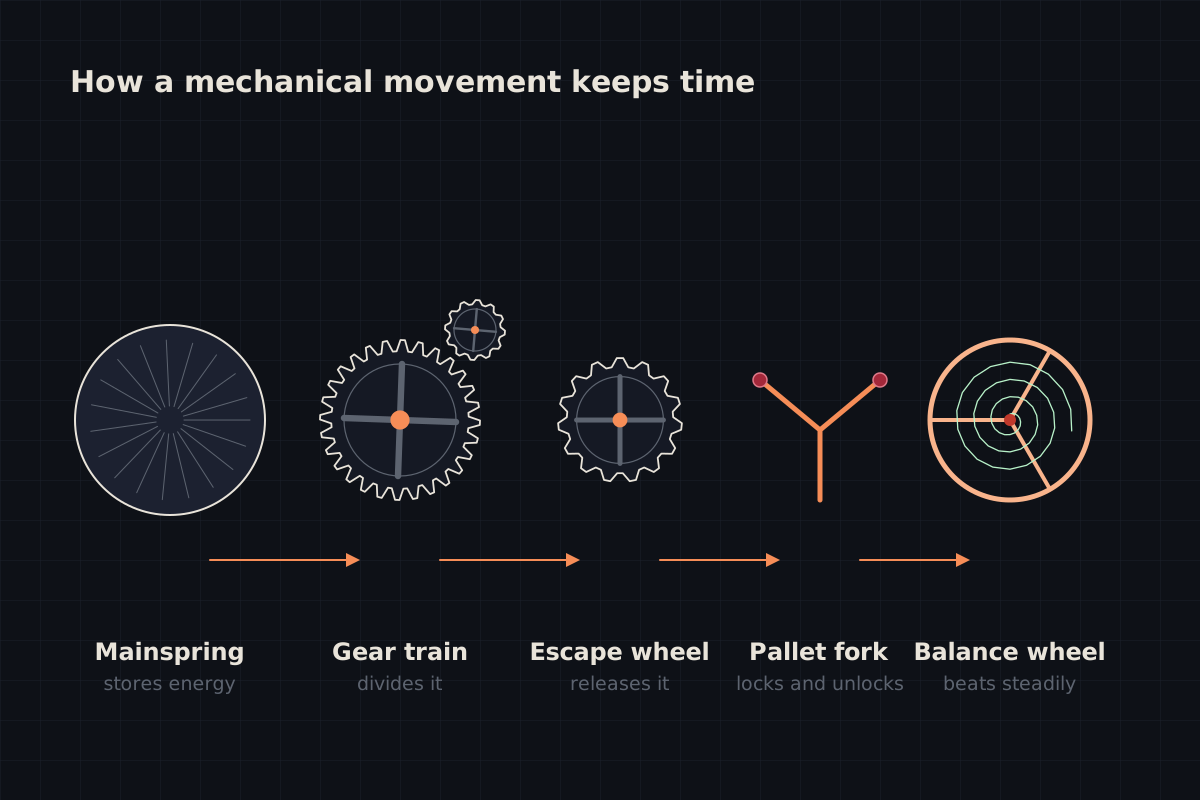
The alternative is a cam and lever system. It does the same job with simpler stamped parts, so it costs far less to produce. As a result, cam designs brought the chronograph to a wider audience. That said, the pushers often feel stiffer. In short, both keep time equally well, and the difference lies mostly in feel and finishing.
Famous chronograph watches and their stories
A handful of models shaped how a chronograph watch looks today. Each one also tells a story about sport, flight or engineering.
OMEGA Speedmaster Moonwatch
OMEGA launched the Speedmaster in 1957 as a racing chronograph. Then, after months of tough tests, NASA declared it flight-qualified for crewed missions in March 1965. A few weeks later, it flew on Gemini III. In 1969, Buzz Aldrin wore one during Apollo 11, so it became the first watch worn on the Moon. Today's version uses the hand-wound Calibre 3861, a mechanical watch movement with Master Chronometer certification.
TAG Heuer Carrera and Monaco
Jack Heuer created the Carrera in 1963 and named it after the Carrera Panamericana road race in Mexico. Its clean, wide dial put legibility first, as the TAG Heuer magazine explains. Later, in 1969, Heuer launched the square Monaco. It ran on the new Calibre 11, one of the first self-winding chronograph movements.
Zenith El Primero
Zenith announced the El Primero in January 1969. It was one of the first integrated automatic watch chronograph movements. Unusually, it beats at 36,000 vibrations per hour, or 5 Hz, so it can measure tenths of a second. In fact, 1969 saw three rival automatic chronographs, from Zenith, the Heuer-Breitling-Hamilton group and Seiko.
Rolex Daytona
Rolex introduced the Cosmograph Daytona in 1963, also with motor racing in mind. Early models were hand-wound. Then, in 1988, an automatic version arrived with a Zenith-based movement. Finally, in 2000, Rolex fitted its own Calibre 4130, and in 2023 it moved to the Calibre 4131.
Quartz vs mechanical chronograph watches
A quartz chronograph watch runs on a battery and is usually cheaper, thinner and more accurate. In addition, some quartz models time to fractions of a second. A mechanical chronograph watch, by contrast, relies on springs and gears. It costs more and needs regular servicing. Still, many buyers prefer it for the craft, the sweeping hand and the satisfying click of the pushers.
Whichever you choose, a chronograph pairs well with other tool watches. For example, a diving watch handles water and dive timing, while a GMT watch helps you track home time on a trip. Overall, if you want one complication you will actually use every day, the chronograph watch is hard to beat. You can read more on its mechanics on Wikipedia's chronograph page.
Frequently asked questions
What is a chronograph watch?
A chronograph watch is a normal watch with a stopwatch built in. You start, stop and reset the timer with pushers on the side of the case, while the main hands keep showing the time. Small sub-dials count the elapsed minutes and hours, and the large centre hand counts the seconds.
What is the difference between a chronograph and a chronometer?
A chronograph describes a function: the watch can time events like a stopwatch. A chronometer describes performance: the movement has passed an official accuracy test, such as COSC certification in Switzerland. A watch can be one, both or neither, so always read the dial and paperwork carefully before you buy.
How do you use a tachymeter?
Start the chronograph as you pass a starting point, such as a kilometre marker. Stop it when you pass the next marker one kilometre later. The seconds hand now points to your average speed on the tachymeter scale. For example, 30 seconds for one kilometre reads 120 km/h on the bezel.
Is it bad to leave a chronograph running all the time?
On a modern vertical-clutch movement, leaving the chronograph running causes little extra wear, although it uses more power. On many older or horizontal-clutch designs, it adds wear and drains the mainspring faster. As a rule, stop and reset the chronograph when you finish timing, and follow the maker's manual for your model.
What is a flyback chronograph?
A flyback chronograph lets you reset and restart the timer with a single press of the lower pusher while it is running. A normal chronograph needs three presses: stop, reset and start. That makes it handy when you need to time one interval straight after another, such as each leg of a flight, without losing seconds.
Sources
- Wikipedia: Chronograph
- Wikipedia: Omega Speedmaster
- TAG Heuer Magazine: Celebrating 60 years of the Carrera
- Time+Tide: The development of TAG Heuer's Calibre 11
- Gear Patrol: 1969 was a watershed year in watches
- Wikipedia: Rolex Daytona
- Aquastar: Column wheel vs cam chronograph
Prices, specifications and availability change. Check the brand's official Malaysian site or an authorised retailer before you buy.