
Mechanical Watch: How It Works, from Escapement to Tourbillon
A clear guide to the spring-driven machines that powered every watch before quartz, and still define fine watchmaking.
Key takeaways
- A mechanical watch runs on a wound mainspring, not a battery, and can be hand-wound or automatic.
- The escapement and balance wheel release energy in even steps; common beat rates run from 18,000 to 36,000 per hour.
- Jewels are synthetic rubies that cut friction at key pivots; 17 jewels was long seen as fully jewelled.
- Skeleton watches show the movement through an open dial; Breguet patented the tourbillon in 1801.
- Most mechanical movements run about 36 to 72 hours per wind and need a full service every several years.
A mechanical watch runs on stored spring power and a set of finely made gears, with no battery at all. Before 1969, almost every watch worked this way. Today, it remains the heart of fine watchmaking. This guide explains how the movement works, from the mainspring to the escapement, and covers jewels, skeleton dials, tourbillons, complications and care.
What is a mechanical watch?
Put simply, it is a small machine that turns the energy of a coiled spring into steady time. You store energy by winding the spring. Then the spring slowly lets it go, while a regulating system makes sure it unwinds at an even rate. So the hands move forward at exactly the right speed, hour after hour.
Mechanical timekeeping has a long history. In fact, the portable spring-driven clock dates back centuries, long before the first wristwatch. You can trace that story in our history of watches. For now, it helps to know that the basic layout has changed surprisingly little, even as materials and finishing have improved.
How a mechanical watch works
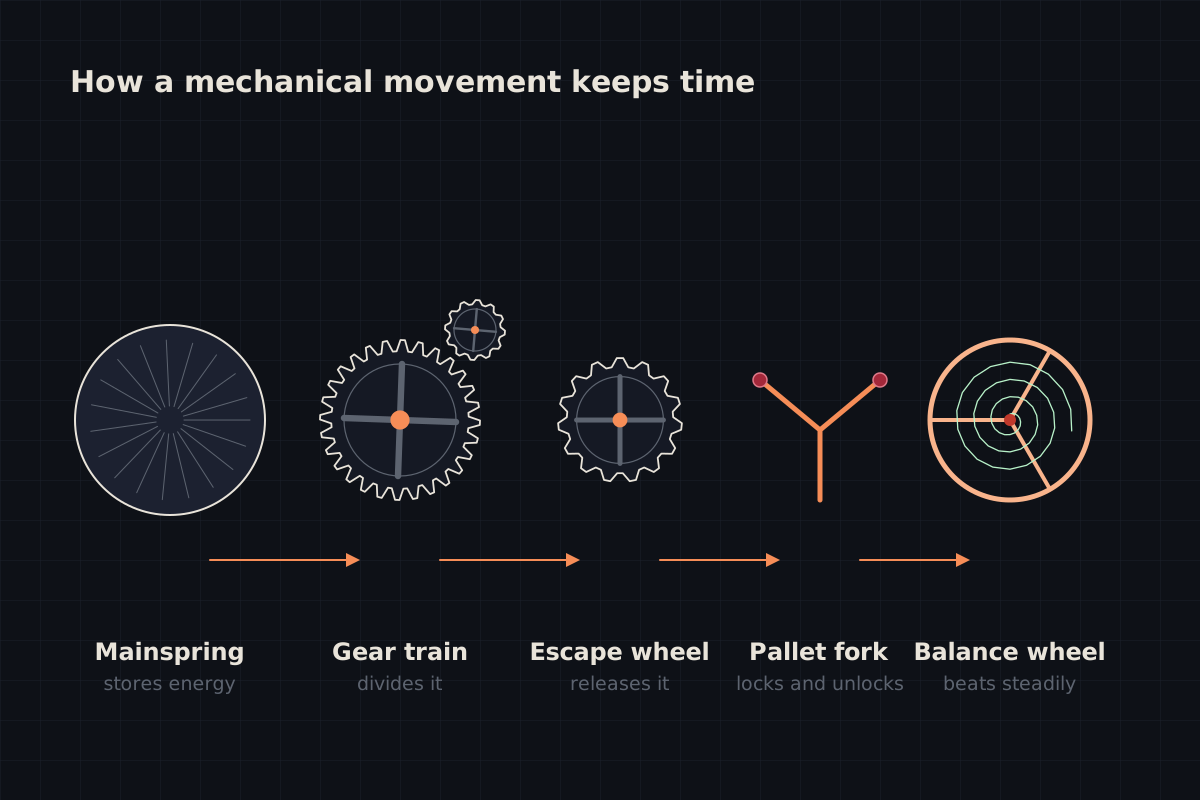
Every movement has five key parts. Together, they form a chain from power to precision. First, the mainspring stores energy. Second, the gear train carries it. Third, the escapement releases it in small steps. Fourth, the balance wheel sets the pace. Finally, the dial train turns the hands.
Mainspring and gear train
The mainspring is a spiral ribbon of spring steel coiled inside a drum called the barrel. As it unwinds, the barrel turns. Its teeth then drive the gear train, a row of wheels that steps down the speed. For example, one wheel, the centre wheel, turns once per hour and carries the minute hand. Smaller gears then drive the hour hand.
The escapement
Left alone, the mainspring would unwind in a second or two. Instead, the escapement holds the gears back and lets them move only one small step at a time. Most modern watches use the lever escapement, which English clockmaker Thomas Mudge invented in 1754. It has two main parts: an escape wheel with pointed teeth, and a pallet fork that locks and unlocks it.
Each time the pallet fork releases a tooth, it also gives the balance wheel a tiny push. That keeps the balance swinging. Meanwhile, the balance swings back and lets the fork release the next tooth. As a result, the escapement does two jobs at once: it controls the gears and it keeps the regulator alive. This is also the source of the familiar ticking sound.
The balance wheel
The balance wheel is the true timekeeper. It swings back and forth on a fine coiled hairspring, much like a tiny pendulum. Because its swing has a fixed rhythm, it sets the speed of the whole watch. Watchmakers adjust that rhythm with small screws or a regulator arm, so the watch runs neither fast nor slow.
Hand-wound vs automatic mechanical watch
There are two ways to wind the spring. A hand-wound model needs you to turn the crown, usually once a day. By contrast, an automatic watch adds a rotor, a half-moon weight that spins as you move and winds the spring for you. Both share the same escapement and balance, so they keep time in the same way.
Each has its fans. Hand-wound watches are often slimmer, because there is no rotor stacked on top. Also, many owners enjoy the daily ritual of winding. Automatics, on the other hand, are easier to live with, since they wind themselves on the wrist. To compare both with battery watches, see our quartz vs automatic watch guide.
Beats per hour in a mechanical watch
Watchmakers measure the speed of a mechanical watch balance in beats per hour, or bph. Each beat is one swing in one direction. Common rates are 18,000, 21,600, 28,800 and 36,000 bph. In other words, the balance swings five, six, eight or ten times every second.
A higher beat rate usually gives a smoother seconds sweep and can help stability. For instance, 28,800 bph means eight small steps each second, which looks almost fluid. However, faster beats also use more energy and can wear parts sooner. So most makers choose a rate that balances smoothness, accuracy and power reserve.
Jewels in a mechanical watch
Look at many a mechanical watch dial and you will see a number such as "17 jewels". These jewels are not gems for decoration. Instead, they are tiny synthetic rubies used as bearings where metal parts pivot or rub. Because ruby is very hard and smooth, it cuts friction sharply compared with steel on steel. As a result, the parts wear more slowly and need less oil.
For many years, a 17-jewel movement was seen as fully jewelled for a simple time-only watch. Higher counts usually support extra functions or the automatic winding system. So a bigger number does not always mean a better watch. It simply tells you how many friction points the maker chose to protect.
Power reserve and accuracy
Most mechanical watch movements run between about 36 and 72 hours on a full wind, though some last a week or more. Accuracy varies with quality. A decent movement may drift a few seconds a day, while a certified chronometer must average between minus 4 and plus 6 seconds a day under COSC rules. By comparison, quartz is far more precise, but many owners accept that trade for the craft.
The skeleton watch
A skeleton watch has an open or cut-away dial, so you can see the movement working. In many designs, the watchmaker also cuts away metal from the bridges and plates. This leaves a fine lattice that shows the gears, spring and balance from the front. It is one of the most visual ways to enjoy a movement.
Good skeleton work on a mechanical watch takes real skill, because removing metal can weaken parts if done badly. Finer makers also bevel and polish every cut edge by hand. That said, a busy skeleton dial can be harder to read at a glance. So if legibility matters most, a dial with a small aperture may suit you better.
The tourbillon watch
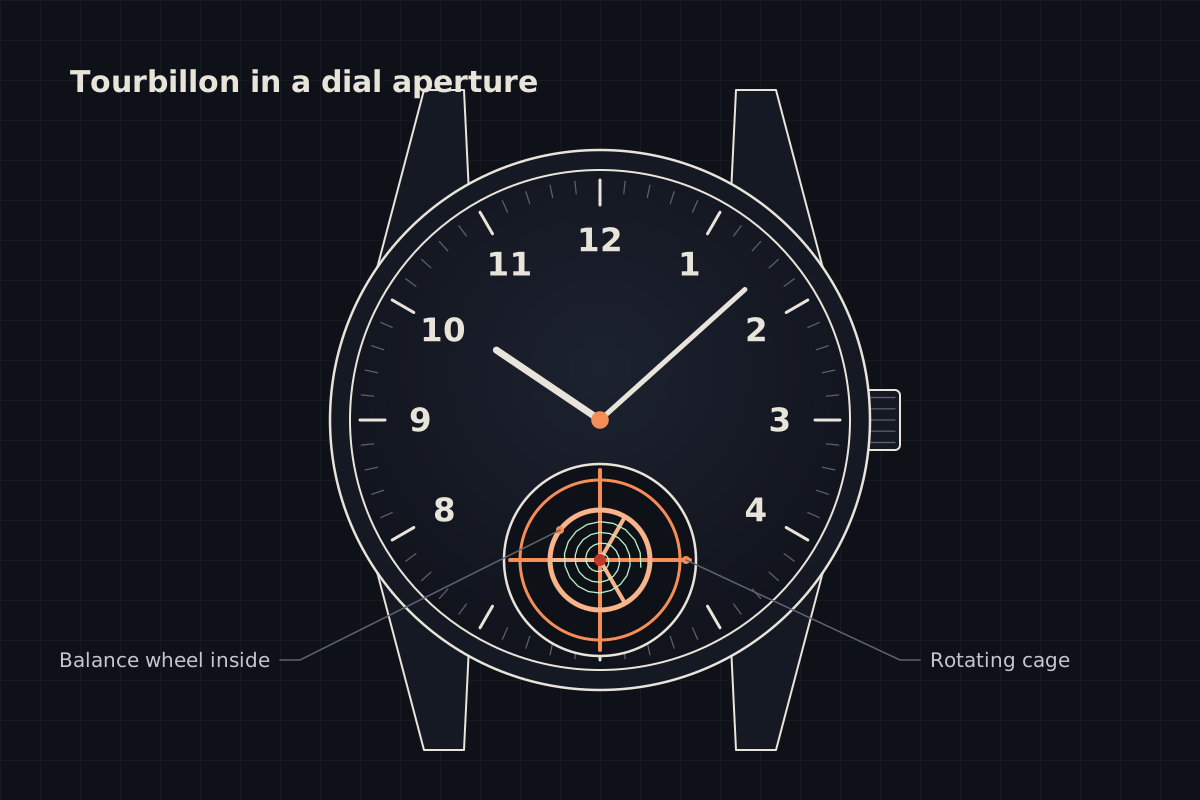
A tourbillon watch places the balance wheel and escapement inside a small rotating cage. The cage usually turns once a minute. Abraham-Louis Breguet patented the design on 26 June 1801, although Wikipedia notes that British watchmaker John Arnold had explored the idea earlier. The goal was to average out timing errors caused by gravity.
Back then, pocket watches sat upright in a waistcoat for hours, so gravity pulled on the balance in the same direction. By turning the whole regulator, the tourbillon spread that error evenly. On a wristwatch, which moves constantly, the benefit is smaller. Today, the tourbillon is mainly a showcase of skill, and it often appears in the most expensive watch lists.
Common complications
In watchmaking, a complication is any function beyond hours, minutes and seconds. Some are practical, while others are pure artistry. These are the ones you will meet most often:
- Date and day: simple calendar displays, usually through a window on the dial.
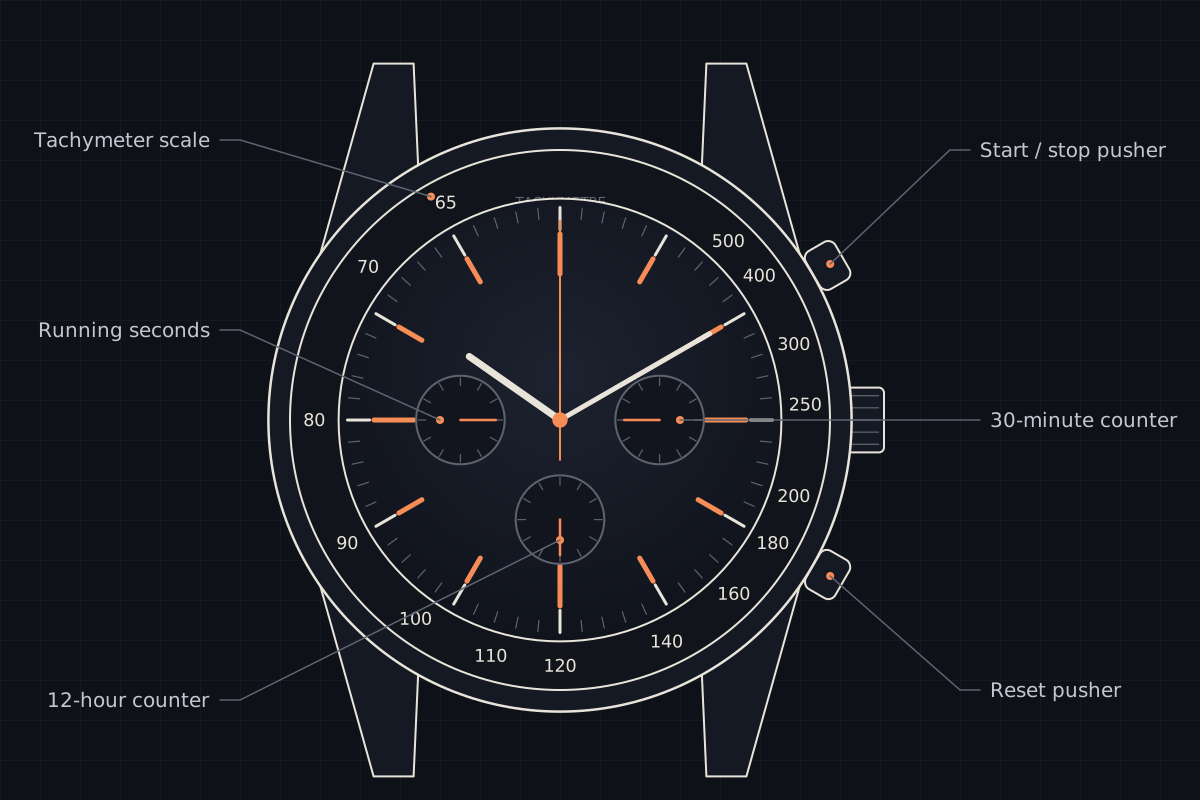
- Chronograph: a stopwatch with start, stop and reset pushers; see our chronograph watch guide.
- GMT: an extra hand that shows a second time zone, ideal for travellers.
- Moon phase: a disc that tracks the lunar cycle in a small window.
- Perpetual calendar: a calendar that adjusts for month lengths and leap years.
- Minute repeater: tiny hammers that chime the time on demand, among the hardest functions to build.
Caring for a mechanical watch
A well-kept mechanical watch can outlive its owner, but it needs regular attention. First, follow the maker's service schedule. Many watchmakers suggest a full service every 5 to 8 years, while some brands advise every 3 to 5. During a service, the watchmaker strips, cleans, oils and regulates the movement, then checks the seals.
Between services, a few habits help. For example, keep the watch away from magnets in phones, tablets and bag clasps, because a magnetised hairspring can make it run fast. Also, avoid hard knocks, and never adjust the date late at night unless the manual allows it. Finally, check the water rating before you swim, especially with an older piece.
Is a mechanical watch right for you?
Choose a mechanical piece if you value craft, heritage and a machine you can hand down. It rewards owners who enjoy winding, servicing and the story behind the dial. Of course, it will never match quartz for accuracy. Still, for many people, that small imperfection is part of the charm. For more technical depth, see the mechanical watch overview on Wikipedia and its entry on the tourbillon.
Frequently asked questions
What is a mechanical watch?
It is a watch powered by a coiled mainspring rather than a battery. You wind the spring by hand, or a rotor winds it as you move. The spring releases energy through a gear train, while an escapement and balance wheel divide that energy into steady beats that move the hands at the right speed.
What is the difference between a mechanical and an automatic watch?
An automatic is a type of mechanical watch. Both use a mainspring, gears and an escapement. The difference is winding: a manual mechanical model needs you to turn the crown regularly, while an automatic adds a rotor that winds the spring from your wrist movement. Hand-wound watches are often slimmer as a result.
What does a tourbillon do?
A tourbillon places the balance wheel and escapement inside a rotating cage, usually turning once a minute. Abraham-Louis Breguet patented it in 1801 to average out errors caused by gravity when a pocket watch sat in one position. Today it is mainly a showpiece of skill rather than a big accuracy gain.
Why do mechanical watches have jewels?
Jewels are tiny synthetic rubies used as bearings at the points where metal parts pivot or rub. Because ruby is extremely hard and smooth, it cuts friction and wear compared with steel on steel. A 17-jewel movement was long considered fully jewelled; extra jewels usually support complications or the winding system.
How long does a mechanical watch last?
With regular servicing, a mechanical watch can last for generations. A watchmaker can clean, repair and even remake its parts, which is why many century-old pocket watches still run. Most makers suggest a full service every several years, and following your manual is the best way to keep it healthy.
Sources
- Wikipedia: Mechanical watch
- Wikipedia: Lever escapement
- Wikipedia: Tourbillon
- Wikipedia: Automatic watch
- Wikipedia: COSC (Contrôle officiel suisse des chronomètres)
- Bob's Watches: Quartz vs automatic movement
- Bulova: Watch movement types explained
Prices, specifications and availability change. Check the brand's official Malaysian site or an authorised retailer before you buy.